Entry Fifteen: What I Fear Most (And What I Don’t)
There is a reason to write this now. It is Christmas time, the end of the year, the season that insists, gently, sometimes not so gently, that you stop moving long enough to take stock. When I was accepted into the Svalbard residency back in August, July felt impossibly far away, almost abstract. A date without gravity. Now it is only six months out. Halfway. The distance between then and now has collapsed into something that feels closer than it should, like time snapping its fingers and moving on without asking.
The project is no longer an idea on paper. It has weight now. Direction. Consequence.
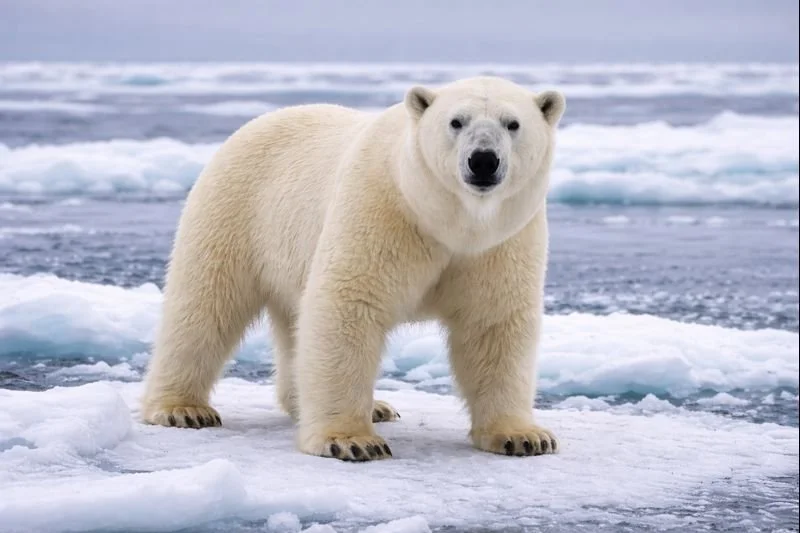
People ask me if I’m afraid. The Arctic has a way of inviting that question. Ice. Distance. Remoteness. I suppose I am worried about the banal, everyday things, the harmless logistics that always accompany travel. Will the plane be on time? Will jet lag flatten me? Will I feel sick at sea? Will I ever feel truly warm? Polar bears exist there, which is both thrilling and absurd to think about in the same sentence as packing socks. These things occupy the mind, but they do not rise to the level of fear. They are background noise. Manageable problems with known shapes.
What I fear most is quieter than that.
I fear that when everything is finished, when the paintings are complete, when the footage is captured, when the effort has been fully spent, it might not reach anyone. That the work could land softly and disappear without consequence. That the loss I am trying to make visible remains unseen. This, more than cold or distance or uncertainty, is what unsettles me. The idea that I might give everything I have to something and fail to connect.
So much of this project is about balance. Preparation versus surrender. Intention versus presence. I plan obsessively, and then I remind myself that the Arctic does not care about plans. I know what the project is, and I also know that I need to let it unfold one day at a time, especially the journey itself. Anticipation is already creeping in. By July, I know I won’t sleep the night before departure. My mind will race ahead of my body. Thankfully, my friend Tom has invited me to stay with him in Denmark before the journey north. He will have to live with my restlessness for a few days, bear witness to the pacing, the half-finished sentences, the nervous energy of someone standing at the edge of something meaningful, hopefully.
I plan to document everything on camera, despite the fact that I am not a cinematographer. This is another unknown. Will there be enough? Will I miss something essential while adjusting a setting or fumbling with a battery? Will there be other artists there who see the world through lenses more fluently than I do, people I might collaborate with, learn from, exchange perspectives with? I don’t know. The project is full of these open-ended questions, and I am learning to let them exist without demanding immediate answers.
But here is what I do not fear.
I do not fear the moment I step onto the boat.
I imagine that moment clearly. The engine’s low hum. The sense of forward motion. The quiet understanding that the list of shoulds and musts no longer applies in the same way. Once I am there, I hope to let go, to be present, to absorb, to inhale and exhale without trying to shape the experience into something productive too quickly. I am deeply excited by the idea of exchange: conversations with other artists, shared silence, the subtle recalibration that happens when people from different places gather around a common purpose.
The last time I felt this kind of shared purpose was at the 1998 Skysurf World Cup in Évora, Portugal. I was competing in skysurfing for Team Austria. It was a small field, tight-knit, most of us already familiar with one another, yet the gathering itself felt vast. People had come from everywhere, from all continents, all countries, too many to list, and despite our different languages, backgrounds, and lives, we were united by a single intention. To climb into an airplane together, to step out of it, and to experience something close to real freedom. That sense of collective focus, of individual risk carried within a common undertaking, is rare. When it appears, you recognize it immediately.
There is far more to look forward to than there is to fear.
I want to change how people look at the loss unfolding in front of them, not through spectacle or accusation, but through attention. Through slowness. Through the quiet realization that something once assumed permanent is not. And in the process, I want to be changed myself. I want to come back altered in ways I can’t fully predict yet: more patient, perhaps; more precise; more willing to sit with uncertainty without trying to solve it. I want the Arctic to leave its mark on how I see time, scale, and my own smallness within it.
If the work succeeds, it won’t be because I controlled every outcome. It will be because I allowed myself to be open, to the place, to the people, to the possibility that meaning emerges not from certainty, but from attention.
And that, I realize now, is not something to fear at all.
“If you are afraid, do it anyway.”