Entry Fourteen: The Arctic Before the Artists
What the world looked like when Rembrandt, Klimt, and Matisse painted, and what it looks like now
When you “read” old paintings as an artist, you are “reading” a weather report as much as you are reading a portrait. An artist chooses light the way a cartographer chooses a coastline. The horizon these men painted was not only a stage for human drama. It was also a record, accidental or deliberate, of what the climate felt like in their time. For this entry I wanted to place their lives on a single northward line and to look at Svalbard and the Arctic in the moments those paintings were made, when they were lost, and today when I will re-make them.
Rembrandt painted his storm in 1633. That century sits deep inside what historians call the Little Ice Age, a period of generally cooler conditions across much of the North Atlantic and Europe. Winters then were harsher by modern standards. Rivers froze that no longer do; coastlines bore different shapes of ice. Northern seas were less hospitable to modern shipping but more generous with drift ice and floes that pushed far south. In short, the world Rembrandt depicted with his men in a small boat was a world that assumed ice had a permanence we no longer feel comfortable assuming.
By the time Klimt was making Philosophy around 1900 the map of human presence in polar regions had begun to change. Industrial whaling had already scarred Svalbard’s animal populations for centuries, and explorers and scientists were starting to keep more regular records. Svalbard itself had entered a new chapter: from seventeenth century whaling stations to nineteenth and early twentieth century coal and polar exploration. The archipelago was never empty of human purpose; it was a frontier for industry and curiosity alike. Visitors then recorded thick, apparently persistent ice and extensive floes around the islands, even as subtle changes were already beginning in the background of long climate rhythms.
Matisse painted in 1919. The early decades of the twentieth century are complex for Arctic climate. The Arctic experienced a notable warming episode from roughly the 1920s into the 1940s, a pattern of high latitude warmth that is distinct from the recent, human-driven trend but important to recognize. Observers at the time recorded variability: some years with thinner ice, others with massive pack ice. Human activity was intensifying in polar regions: more ships, more mapping, more science. These were the years when people still believed regional extremes were isolated curiosities rather than the opening note of a long symphony of change.
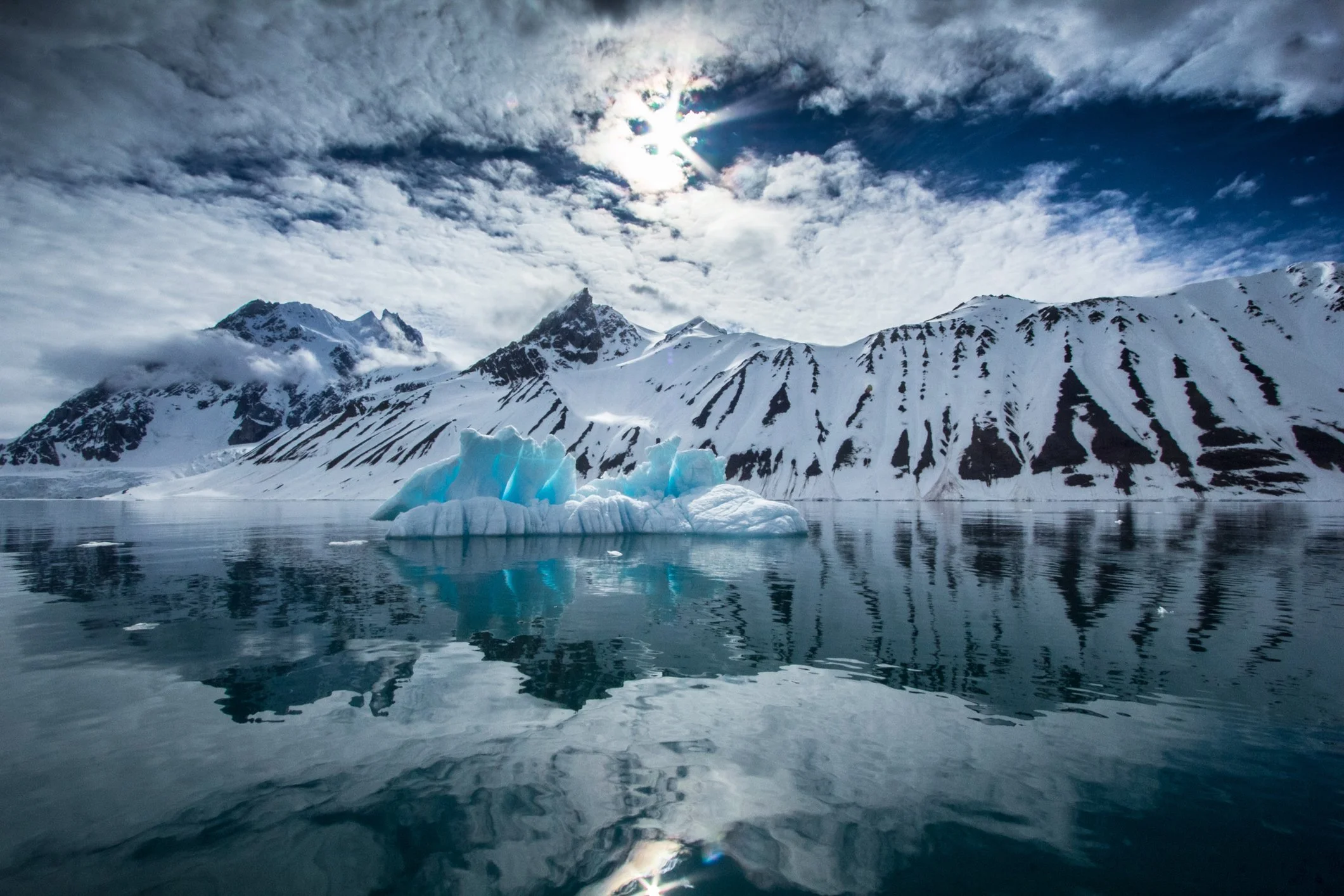
Svalbard’s human story matters to this history because Svalbard is where many Arctic narratives begin. In the 1600s Spitsbergen drew whalers, Dutch, English, German, who set up seasonal stations and carved the names of their industries into the coastline. The place was known, dangerous, and rich. By the nineteenth and twentieth centuries, Svalbard saw mining, exploration, and scientific bases. The island’s people, or the people who visited, measured and recorded, and those records form the long thread by which we can compare past and present.
So what does the comparison show? It shows a world that has always been changeable, but whose rates of change differ. During Rembrandt’s time the Little Ice Age meant more persistent ice at lower latitudes. By Klimt’s day the long cool era had faded and climatologists in later papers note significant early twentieth century variability and warming in parts of the Arctic. In recent decades the change has accelerated into a new category, one that global climate models and observations link directly to greenhouse gas forcing. The Arctic today is warming faster than almost anywhere on Earth; recent winters and summers produced some of the lowest winter sea ice extents on record and dramatic glacier retreat across the region.
Turning from the sea to the land, we can see similar stories in the Alps and closer to home. In 2022 and 2023 most measured glaciers in Austria lost length, with Pasterze, Austria’s largest glacier, recording a record retreat. Projections now warn that large parts of the Alps could be largely ice-free within forty to fifty years if current trends continue. Those numbers made my memory of a frozen pond feel less like nostalgia and more like a warning.
One more technical point worth tying into the art. Sea ice is not measured by romantic feeling; it is mapped in square kilometers and imaged by satellites. Reconstructions that combine tree rings, sediment cores, and modern satellite data show that Northern Hemisphere sea ice has been trending down over recent decades relative to the last centuries. That decline matters for ocean circulation, ecosystems, and weather patterns far beyond the Arctic itself. When you stand at the lip of a glacier or on a high arctic deck and look at an expanse of blue where there should be white, you are watching a change that once seemed slow and impotent become consequential in ways most of our grandparents never imagined.
Why does this matter for the work I am making? Because each of the three paintings I revisit, Rembrandt’s storm, Klimt’s philosophy, and Matisse’s reading girl, are time stamps. They fix a human perception of the world at the moment. The paintings embody light, atmosphere, and human relation to place. If I rebuild their images using pigments that respond to heat, and if I stage those images beside the changing Arctic in a documentary, then the paintings become instruments of comparison. They will let viewers feel the difference between a world imagined in 1633, 1900, or 1919 and the world we know now.
There is another, smaller way the past matters. Records from whalers, explorers, and early scientists are not just curiosities to read. They are data points. Logs that note when pack ice arrived, when harbors froze, when whales were abundant, when villagers reported glacial advances or retreats. All these fragments construct a narrative that links humans to place in a fashion similar to a painting that links color to light. When I stand with a scientist on the deck and they point to old charts or to a notated log, I feel the painter’s and the scientist’s voices coinciding. They both ask: what did the world look like then, and what does it mean that it looks different now?
I am trying to avoid the trap of moralizing. The history does not give us villains and heroes in this simple story. It gives us a longer record of human life in a changing theater: the hunters of the 17th century, the miners and explorers of the early 20th century, the scientists and tourists now using GPS and satellites. The changes are not moral failures so much as physical events accelerated by a particular kind of modern activity whose consequences have taken time to become visible in daily life.
Finally, a documentary can do what a painting cannot on its own. A painting can hold a temperature, a composition, a lost face. A film can organize time. It can place 1633 next to 1900 next to 1919 and next to 2025 and say: look. Here are the seams. Here are the differences. In that sense the film is not a lecture. It is a conversation conducted in images, interviews, data visuals, and the quiet of ice. It will not simply show what has been lost. It will try to show how loss accumulates as habit, as forgetting, as the small choices we make every day.
“What we see changes what we know. What we know changes what we see.”