Entry 042: Day 06: What the Ship Remembered
The captain had said forty-five degrees and I want to report that from where I was lying it felt like every one of them. I was on the right side of the ship, which was the lucky side for the first half, and for four hours I lay pressed against the wall like a man who had chosen well in life. Then at four the ship came about and the wall went away and I spent the rest of the night in the business of not falling out of bed. This was the one night I wore a patch. I had carried sixteen of them across two continents and given nearly all of them away, and on the twentieth of July I finally used one on myself, and it worked, and I woke up hungry.
Sørkapp happened while I was doing this. Sarah's log has the wind dropping in the small hours, the reef coming out of the main and the schooner, the ship jibing west against the current, and then the engine going on at 04:25 to bring us around the southern cape of Spitsbergen. I have no memory of any of it. The track knows exactly where I was, three in the morning at 76° 25,6' N still short of the corner, six in the morning at 16° 58,8' E and heading east, but the man in the bunk was contributing nothing.
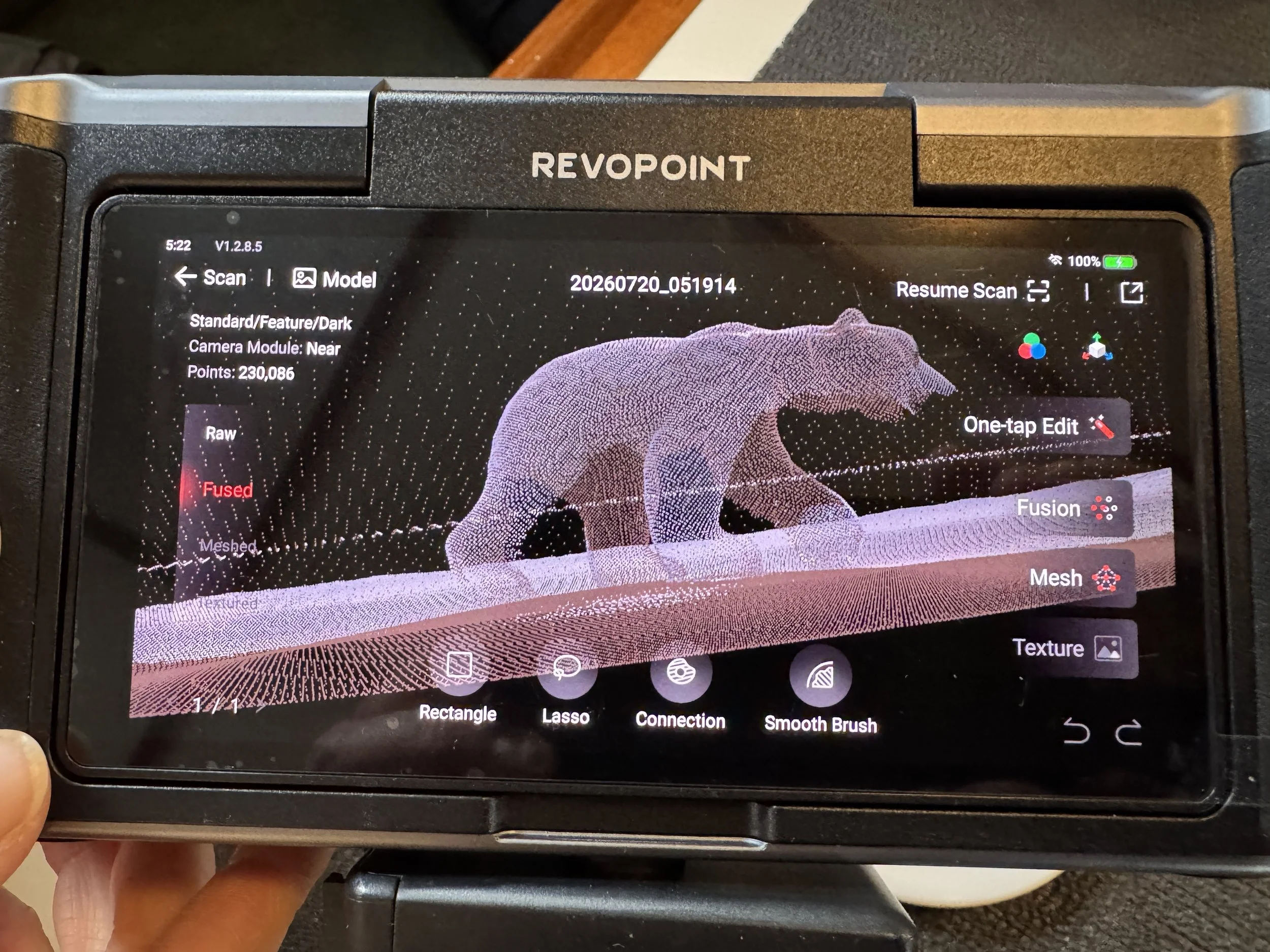
Ling-lin was already up. Her scanner file from that morning is stamped 05:19, which means that while the engine was pushing us around the bottom of the archipelago she was somewhere below decks scanning a plastic polar bear. Julie was up too. Julie was always up. She is Australian and she got to that table before the rest of us every single morning of the voyage, which by day six I had stopped treating as a coincidence and started treating as a discipline.
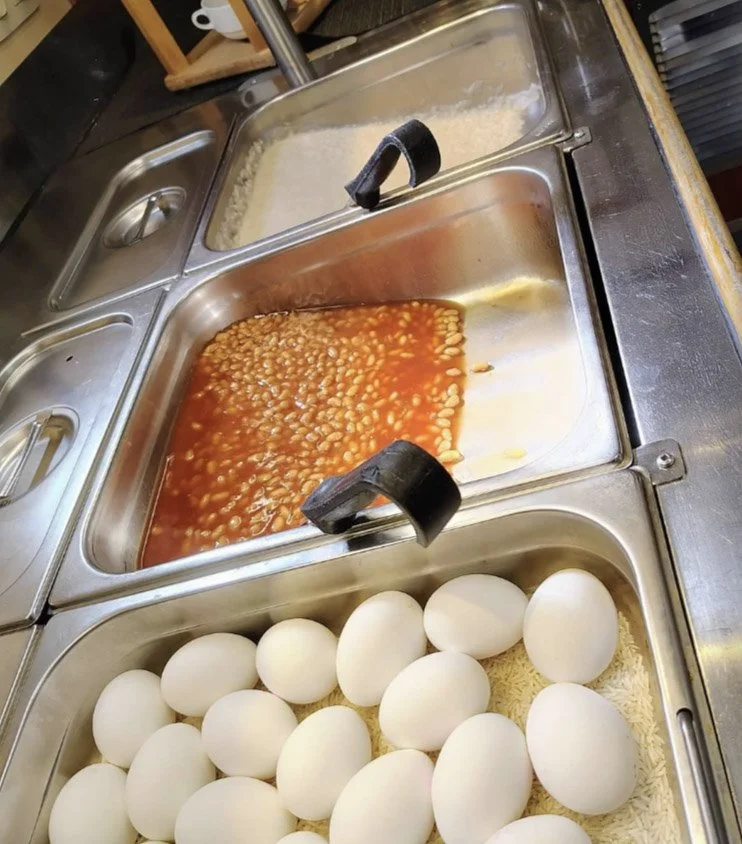
Otherwise the breakfast room was close to empty. Bob photographed the chafing dishes and his picture does the work my memory cannot. A tray of eggs, a tray of rice, and a tray of baked beans sitting at a slope with all the sauce gathered on one side, held there by the ship. Nobody had to describe the night after that. The beans had already filed the report.
Photos: Bob Winfree, Christina Olson
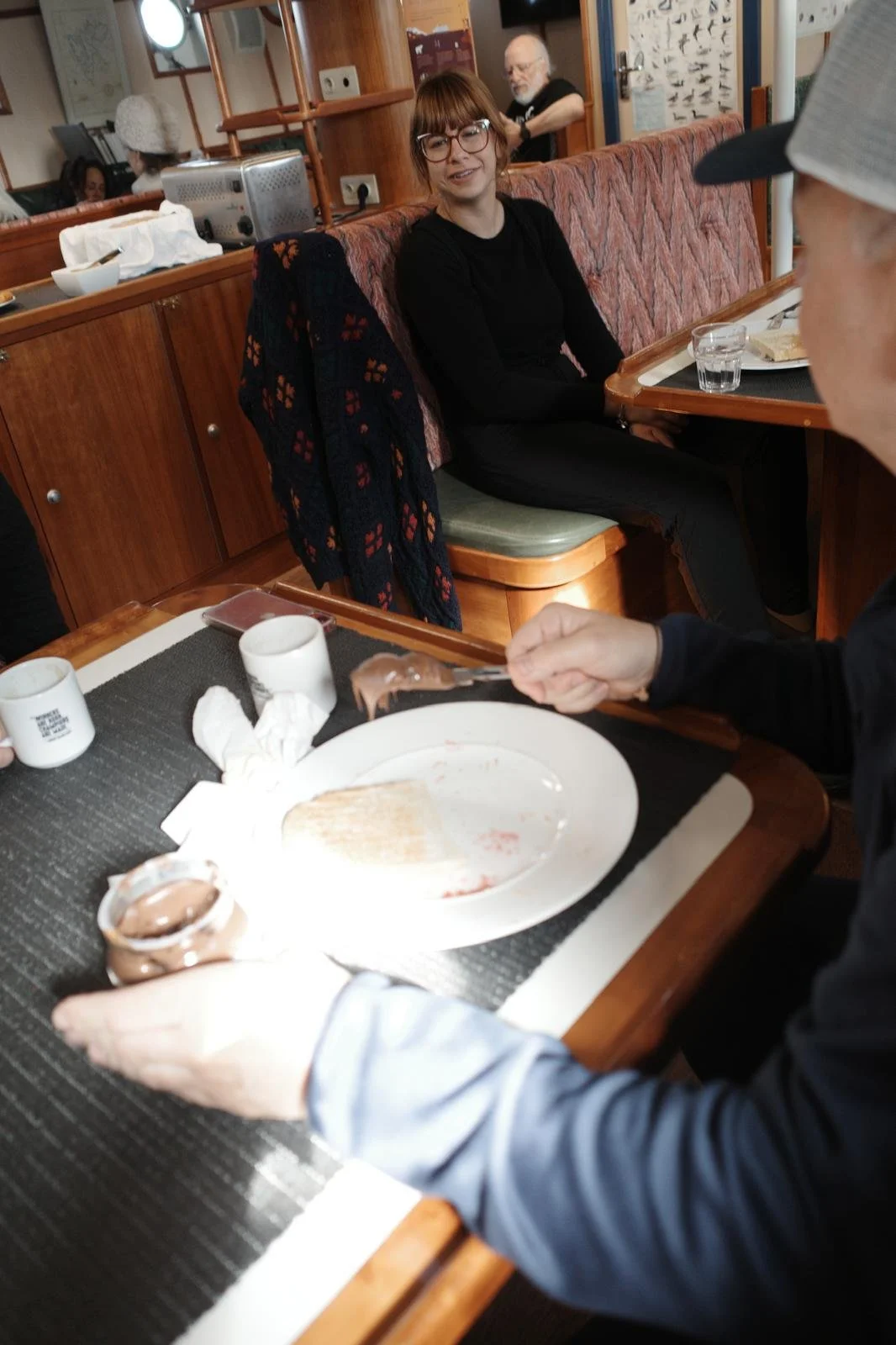
Which brings me to the Nutella. There was a rumour going around that I had personally consumed the ship's entire supply, and I want it on record that Hattie was in on it and Gergő was in on it and Cathleen was spreading it on cookies. Four jars for twenty-eight people over sixteen days works out to roughly a teaspoon each per morning, and nobody on that ship took a teaspoon. Those jars were finished the moment they came aboard. Somebody was always going to take the fall. Christina photographed me mid-crime, my hand and the tub in the same frame, which is the kind of evidence you cannot argue with, and I did not much want to.
I went up and looked at the deck and the sails were full and we were moving. Sarah's log calls it good speed and a bit of heeling and the engine off at 06:45, and then a morning that swung back and forth all day, the wind falling away behind every mountain and coming back over every glacier, sails up, sails down, engine on, engine off. The outer jib came down at 07:50 and the main at 08:15 and the inner jib at 12:50 and the fore stay sail at 13:05, which reads like chaos on the page and was simply a ship paying attention.
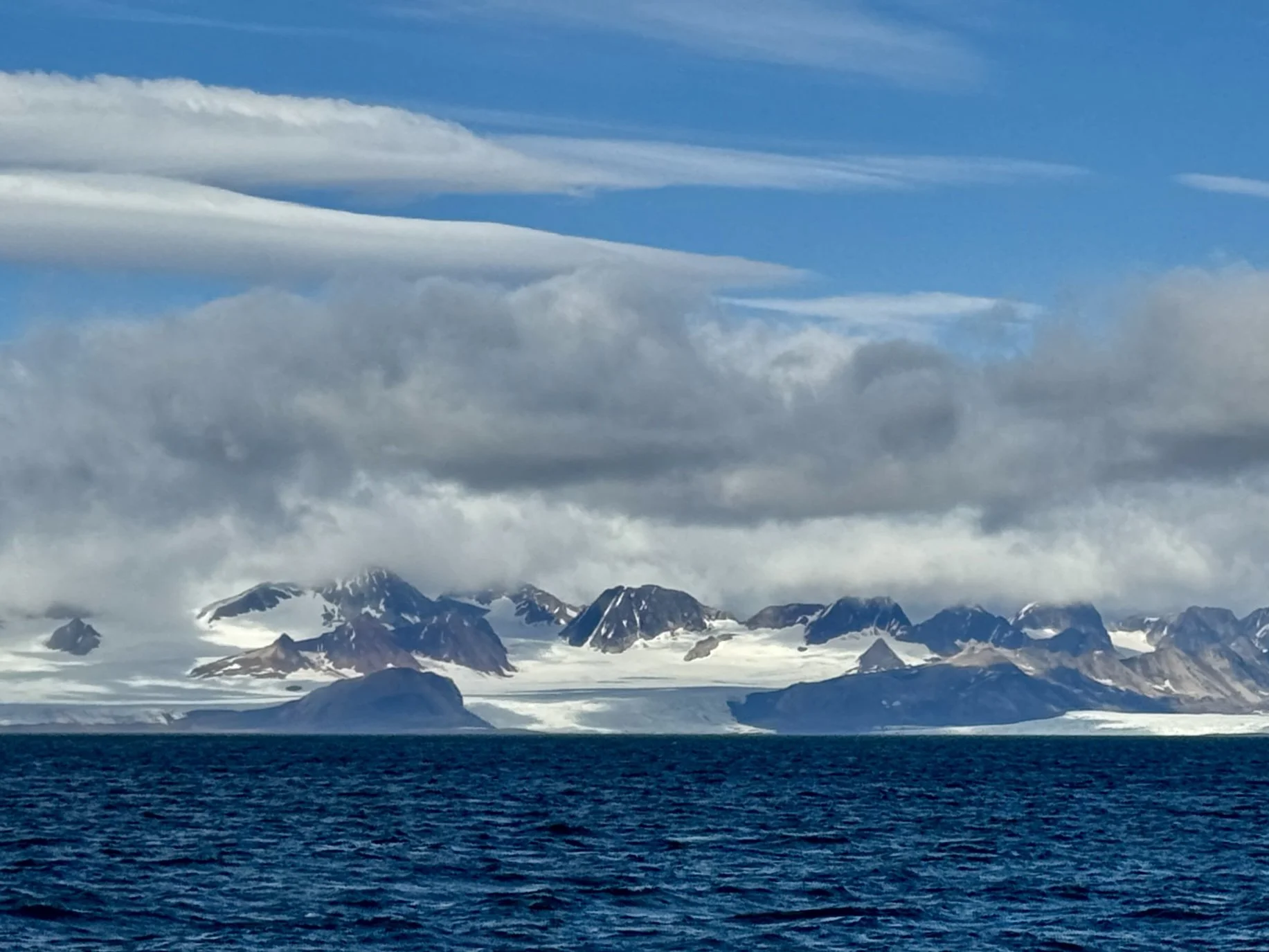
The land going past was covered in snow and the light kept opening and closing. I went looking for someone to play chess with and there was nobody left. Everybody was polite about it. Everybody had something else on just then. By day six the board had become a thing people walked past while making meaningful eye contact with the horizon, and I had done that to myself, one game at a time. So I sketched instead. I drew a polar bear and I drew a wolf, neither of which was in front of me.
Late morning the captain gave a sailing lesson on deck. He stood in front of us in a hi-vis vest with the sails set behind him and went through the whole rig, the sails at the front and the ones in the middle and the ones at the back, what each one is called and what it does and why you put them up in one order and take them down in another. On the seventeenth they had gone up from the back forward and come down from the front backward, and there is a logic to that which he explained and which I understood completely for approximately one hour.
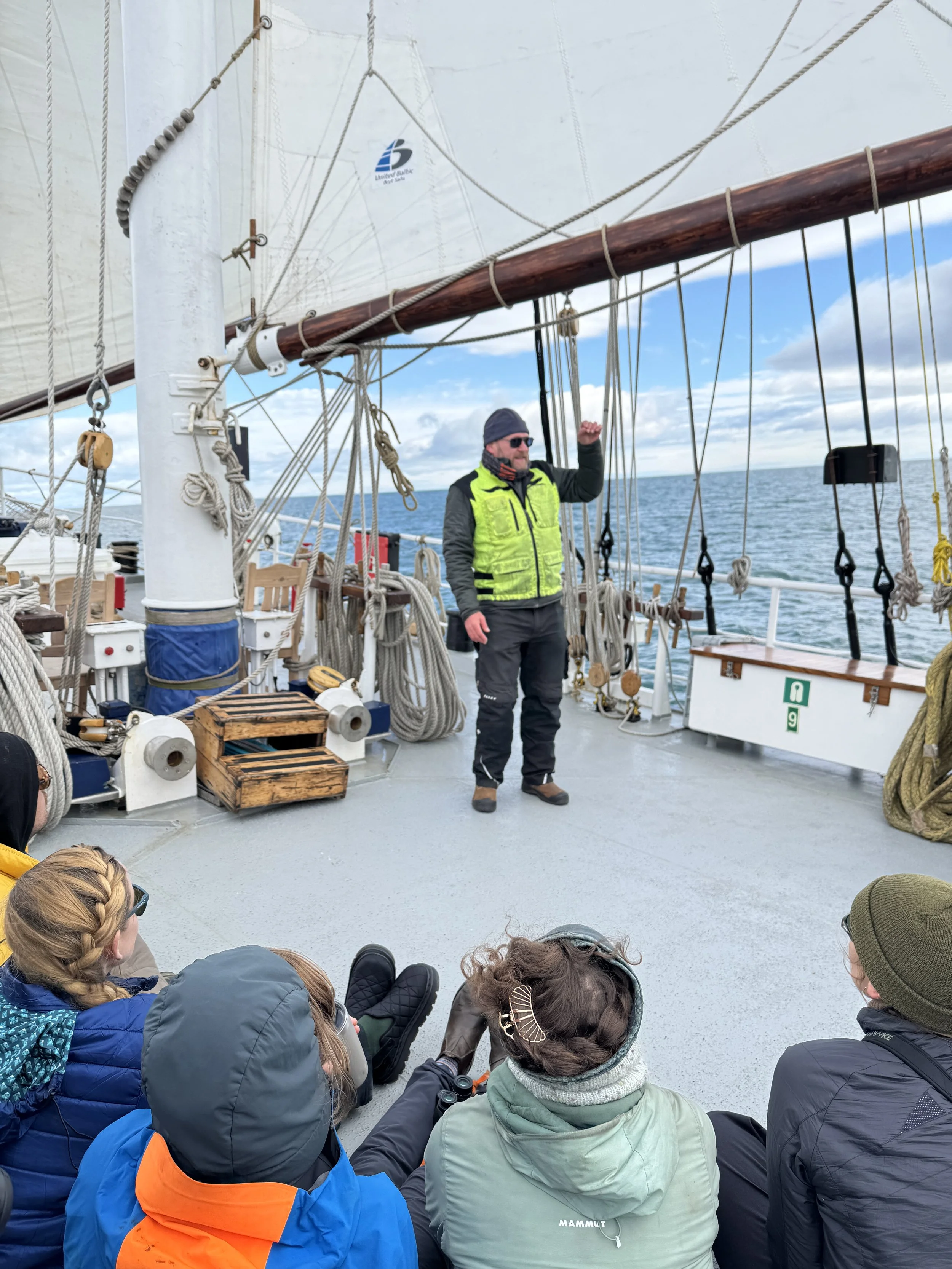
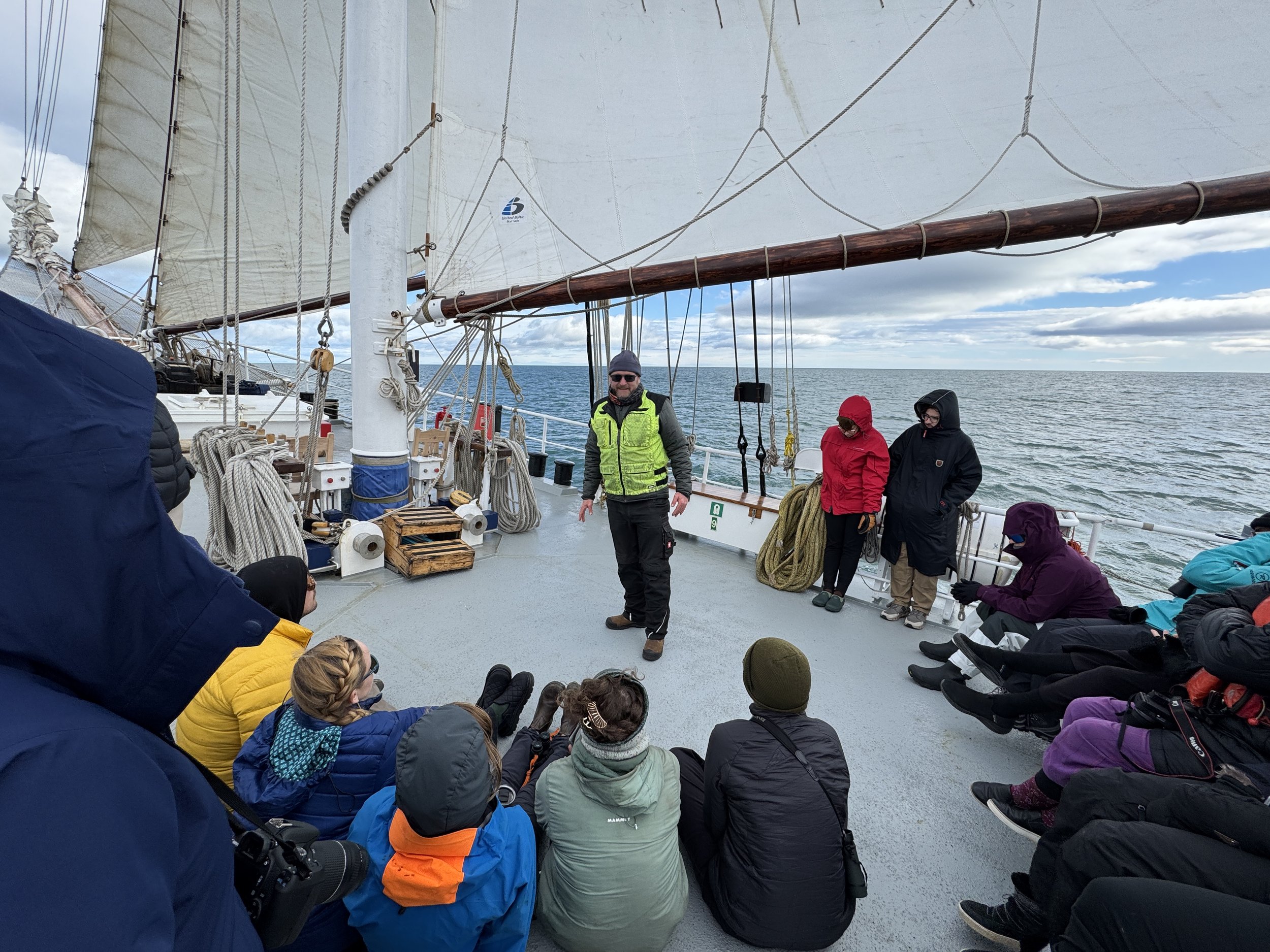
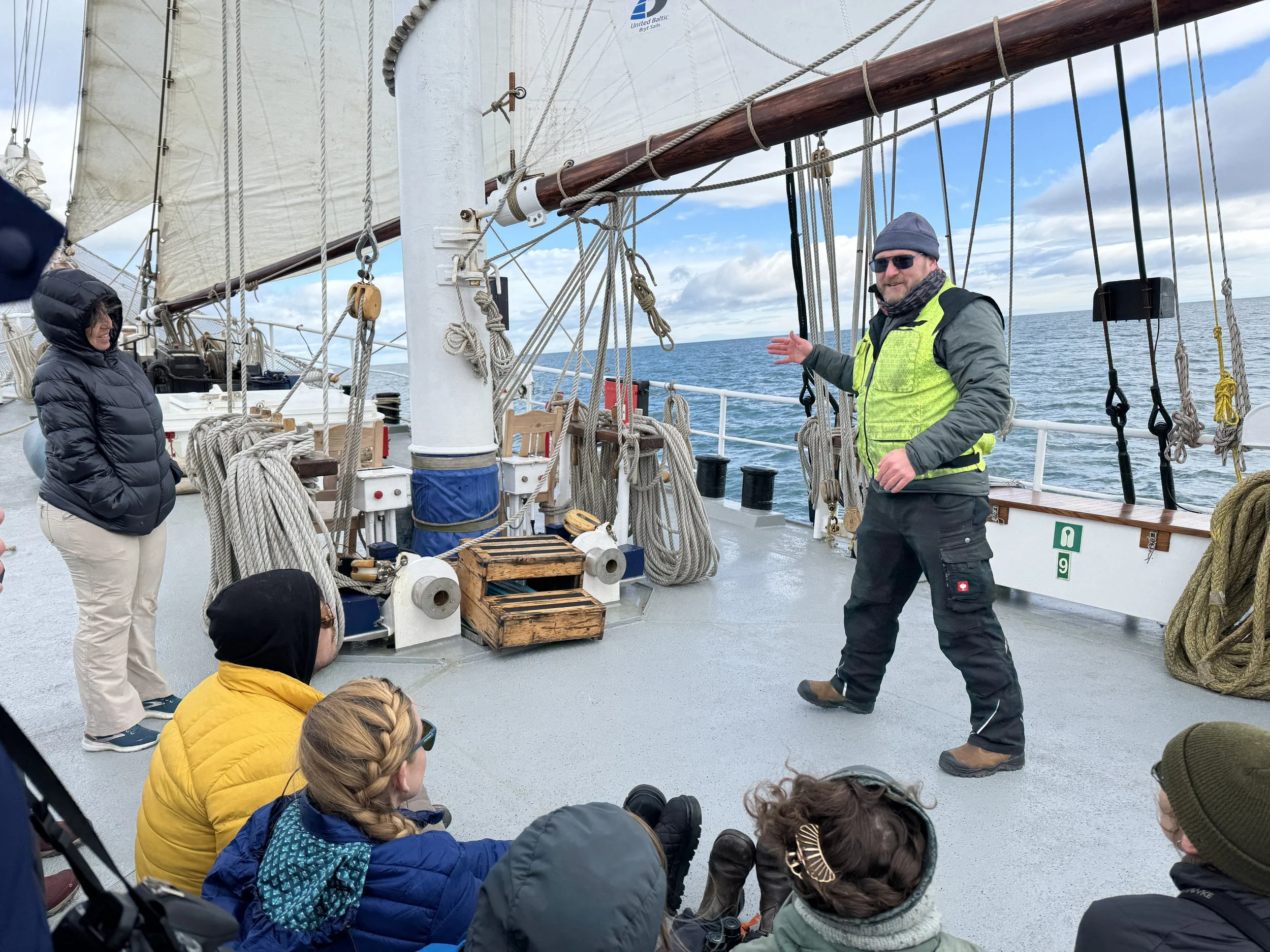
I can tell you now that the ship carries a main sail, a schooner sail, a fore stay sail, an inner jib, an outer jib, a flying jib and topsails, and I can tell you that only because Sarah wrote it down every single day. What I cannot do is tell you which one he was pointing at. Everybody sat on the cold deck with their hoods up and their faces turned toward him and it was interesting and he was good and I have kept almost none of it. I wish I had recorded it. I did not record it.
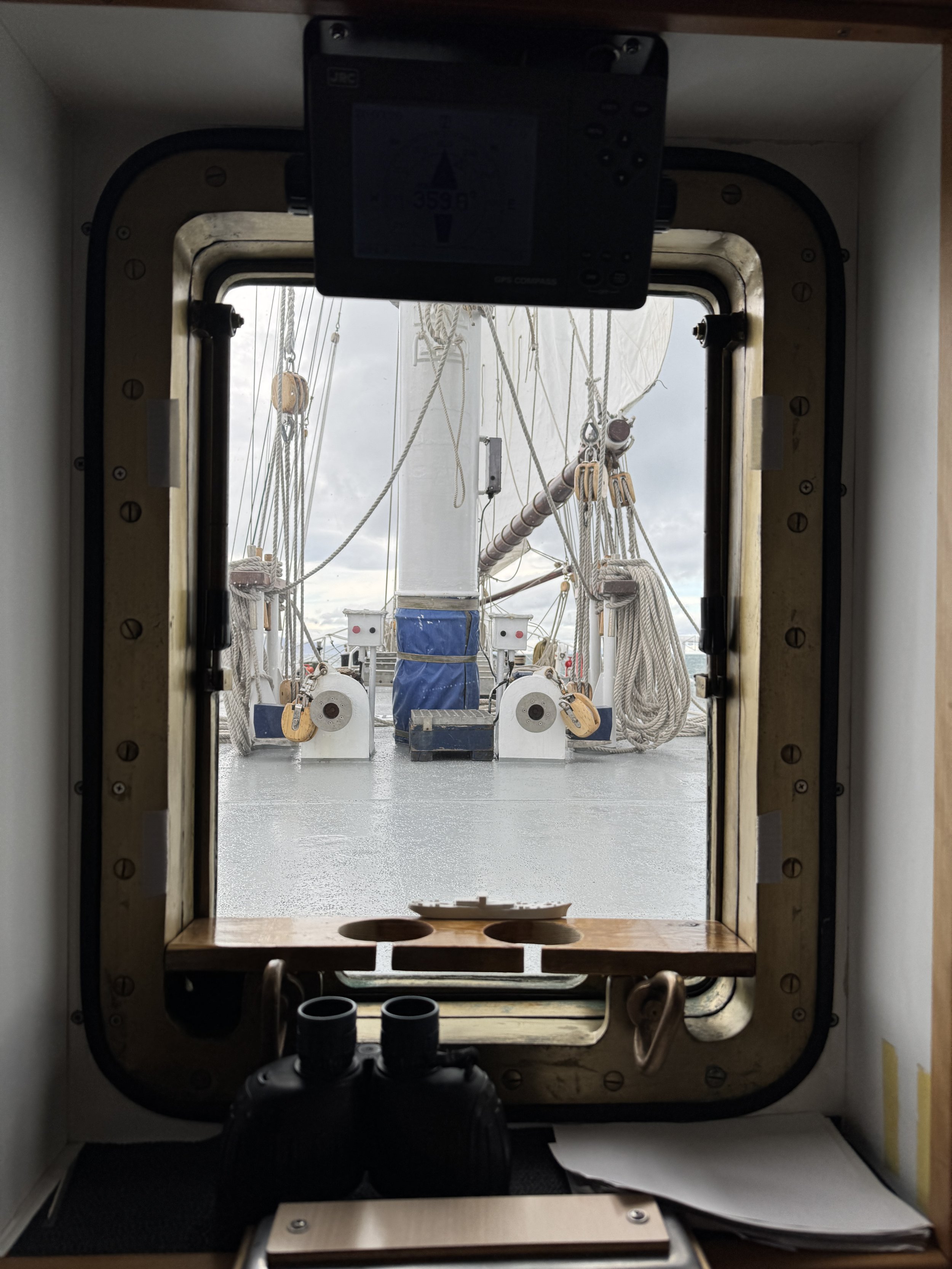
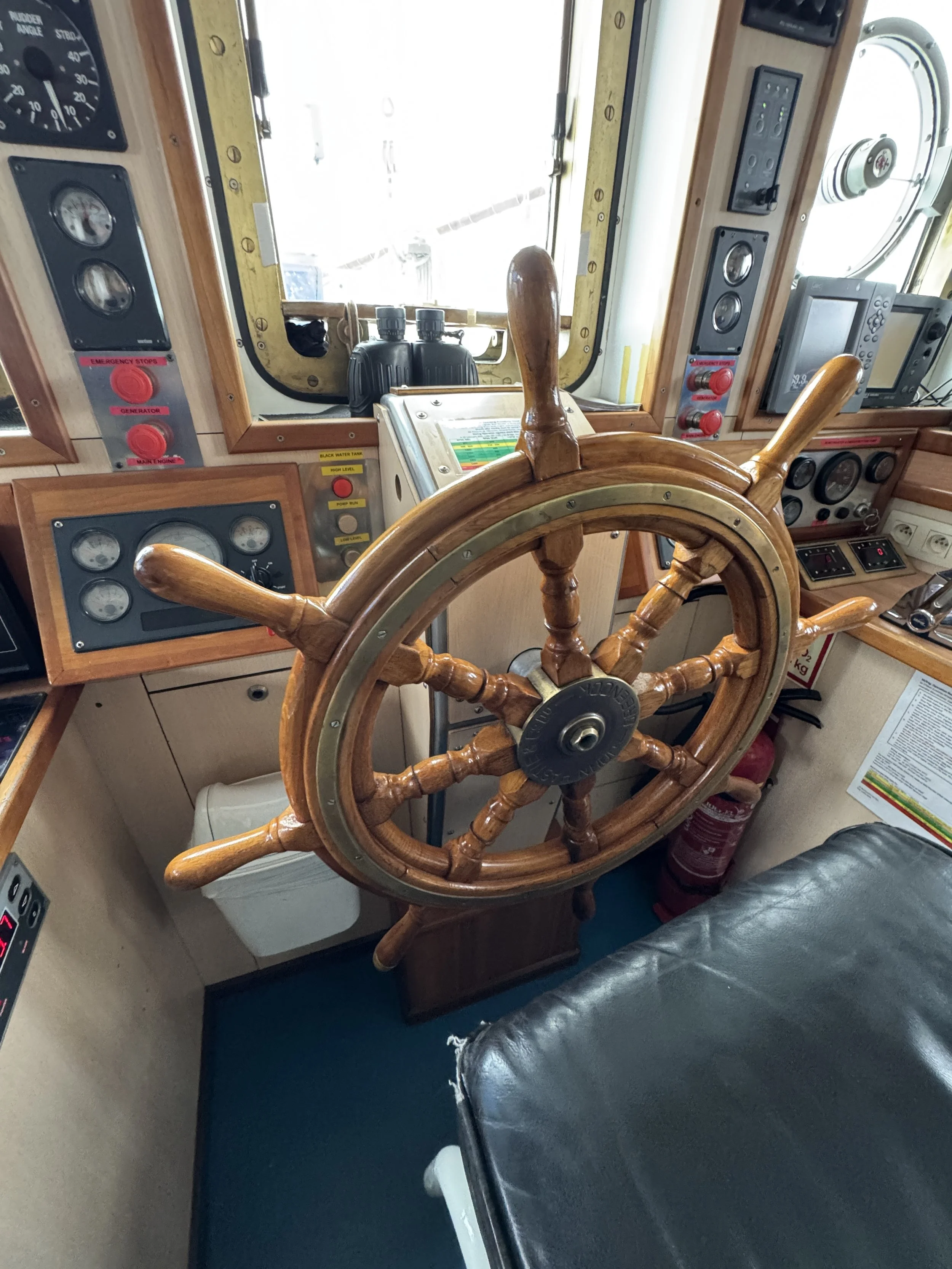
Afterwards Cathleen and I went up to the bridge. The door was always open. That was the arrangement from the first day and we were told repeatedly that we were welcome, and at the end of the trip I heard the crew had rather hoped more of us would take them up on it. There is a lesson in there about invitations. Jeroen was up there when we arrived and did not seem remotely surprised to see two artists wander onto his bridge in the middle of the morning. It was quiet and warm and enormously satisfying, the wheel in polished wood with a brass ring around it, banks of dials and switches and two red emergency stops, a chart taped to a board, and a compass reading 359.6 degrees, which is as close to due north as makes no difference. Somebody had put a small wooden model of a ship on the sill of the forward window, so that if you lined it up right there was a tiny Rembrandt sailing across the real deck.
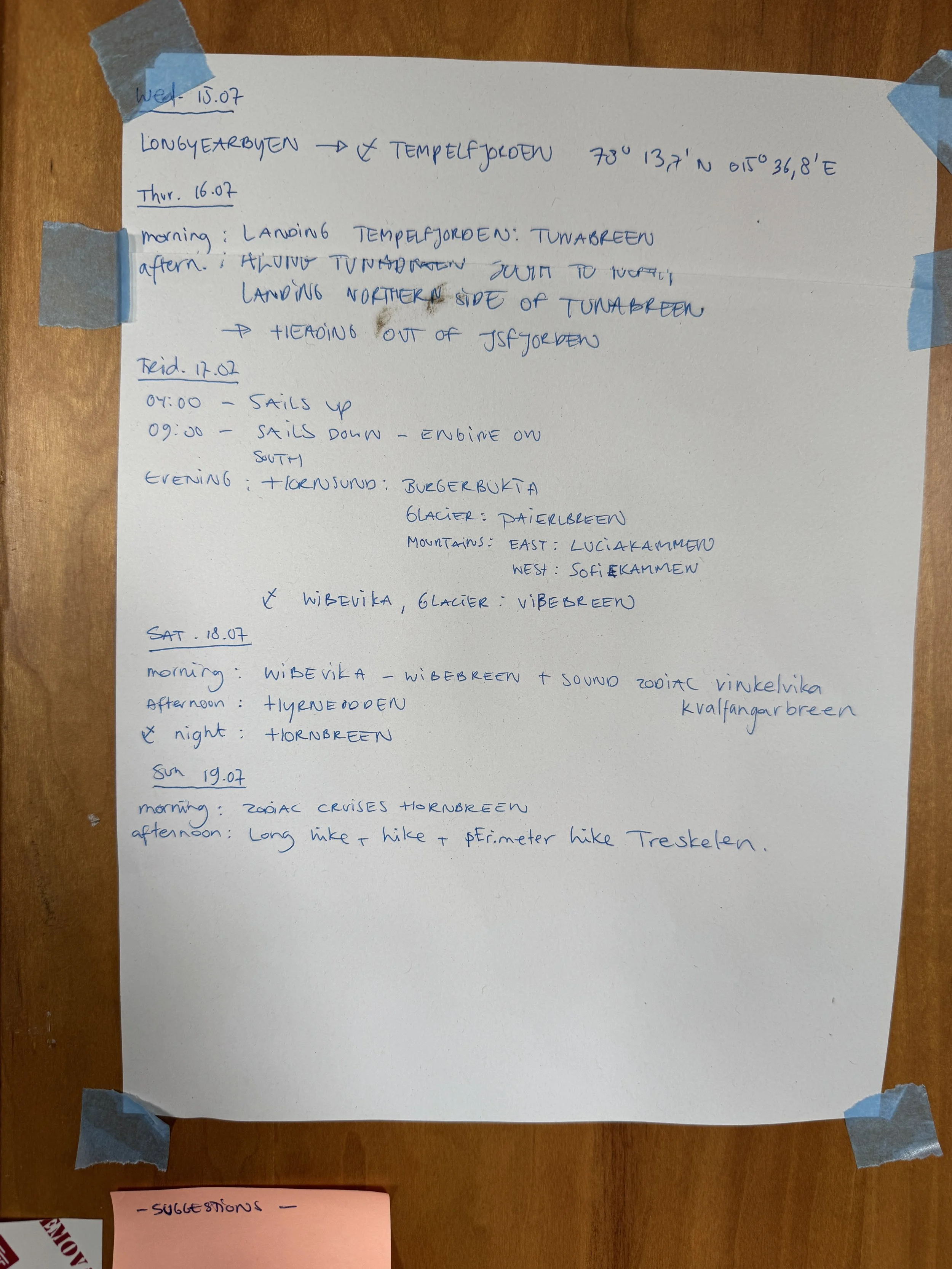
The route sheet was taped to the wall below. Wednesday the fifteenth, Longyearbyen to Tempelfjorden. Thursday, Tunabreen. Friday, sails up at four. Sunday the nineteenth, zodiac cruises Hornbreen, long hike and hike and perimeter hike at Treskelen. Then nothing. The list stopped where we were, because up here nobody plans further ahead than the weather allows.
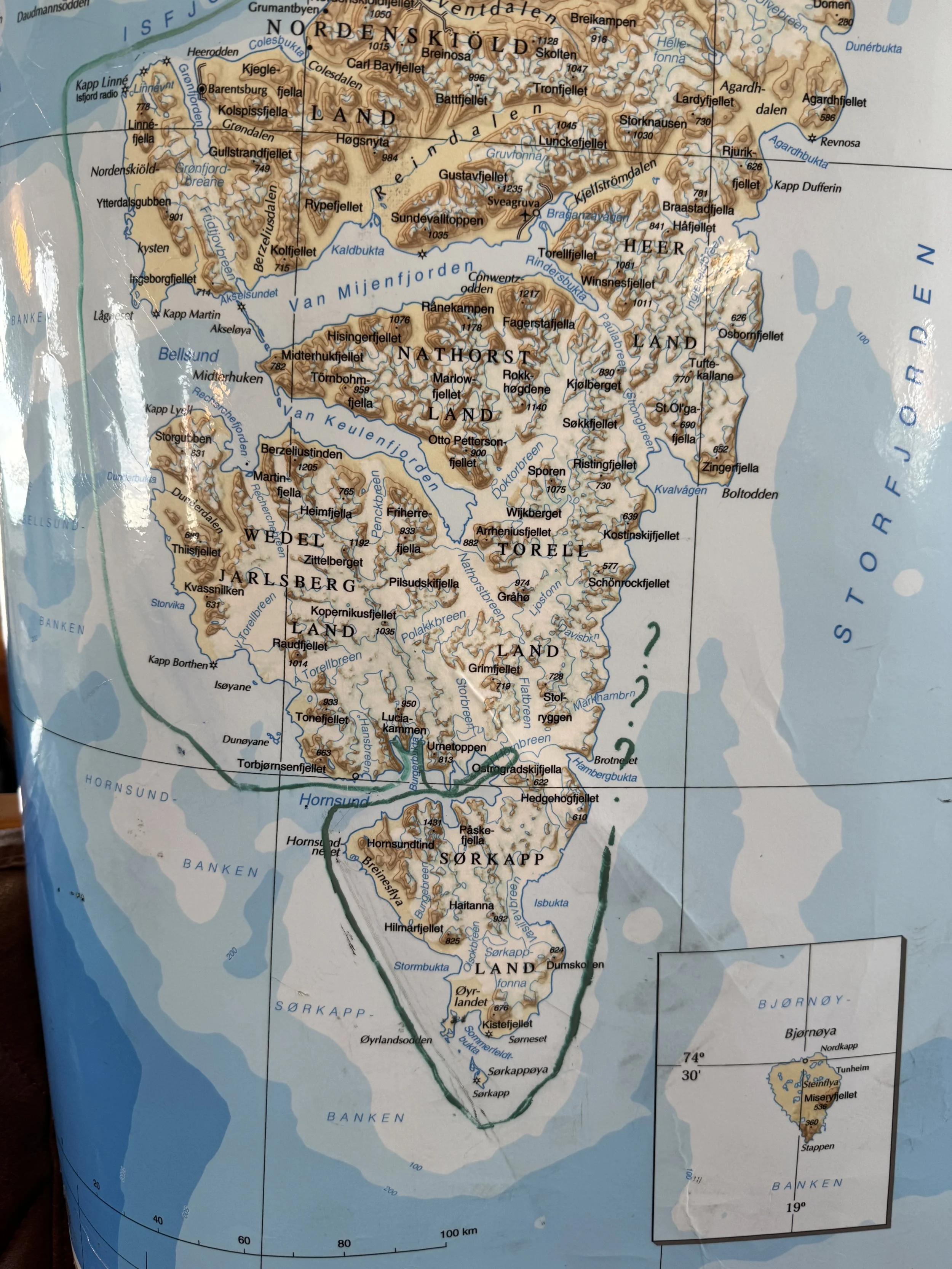
There was a map on the wall too, the whole southern end of Spitsbergen, with a green line drawn around our route by hand, down the west coast and around Sørkapp and up the east side. Rhys or Sarah did those. And somebody had put three green question marks in the water off Hambergbukta, right at the point where Hornbreen holds the land together, which struck me as either a navigational note or the most accurate piece of climate writing on the ship.
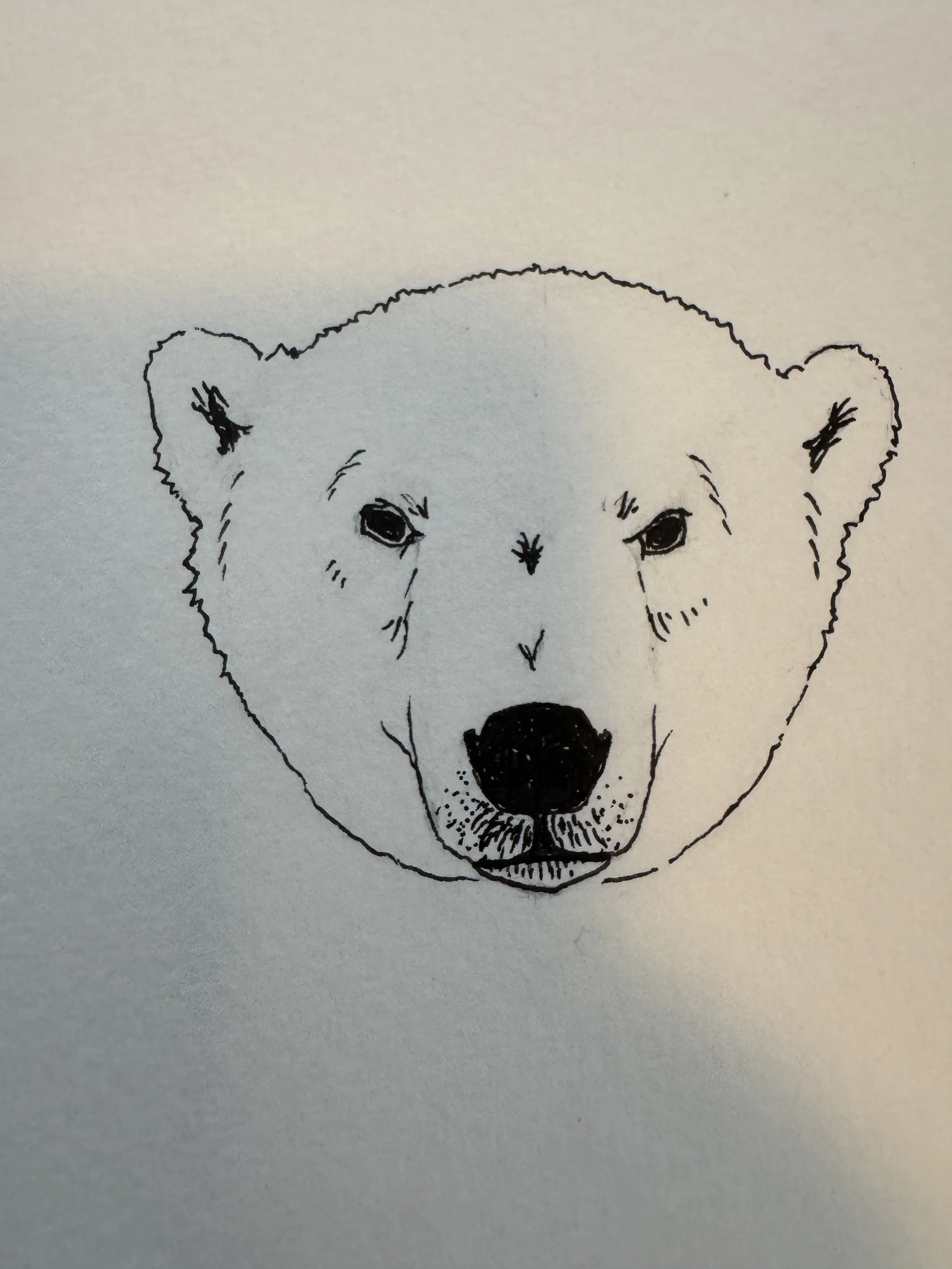
We were going up the east coast now, and this is where I heard the sentence that changed the rest of the trip. This is where the bears are. Maggie was drawing one at the table at the time, a polar bear's face in ink, because I had been saying for days that I wanted a line tattoo of one and she was kind enough to simply make it. Cathleen wants a walrus. Neither of us has gone through with it. We are both, as of this writing, still walking around undecorated.
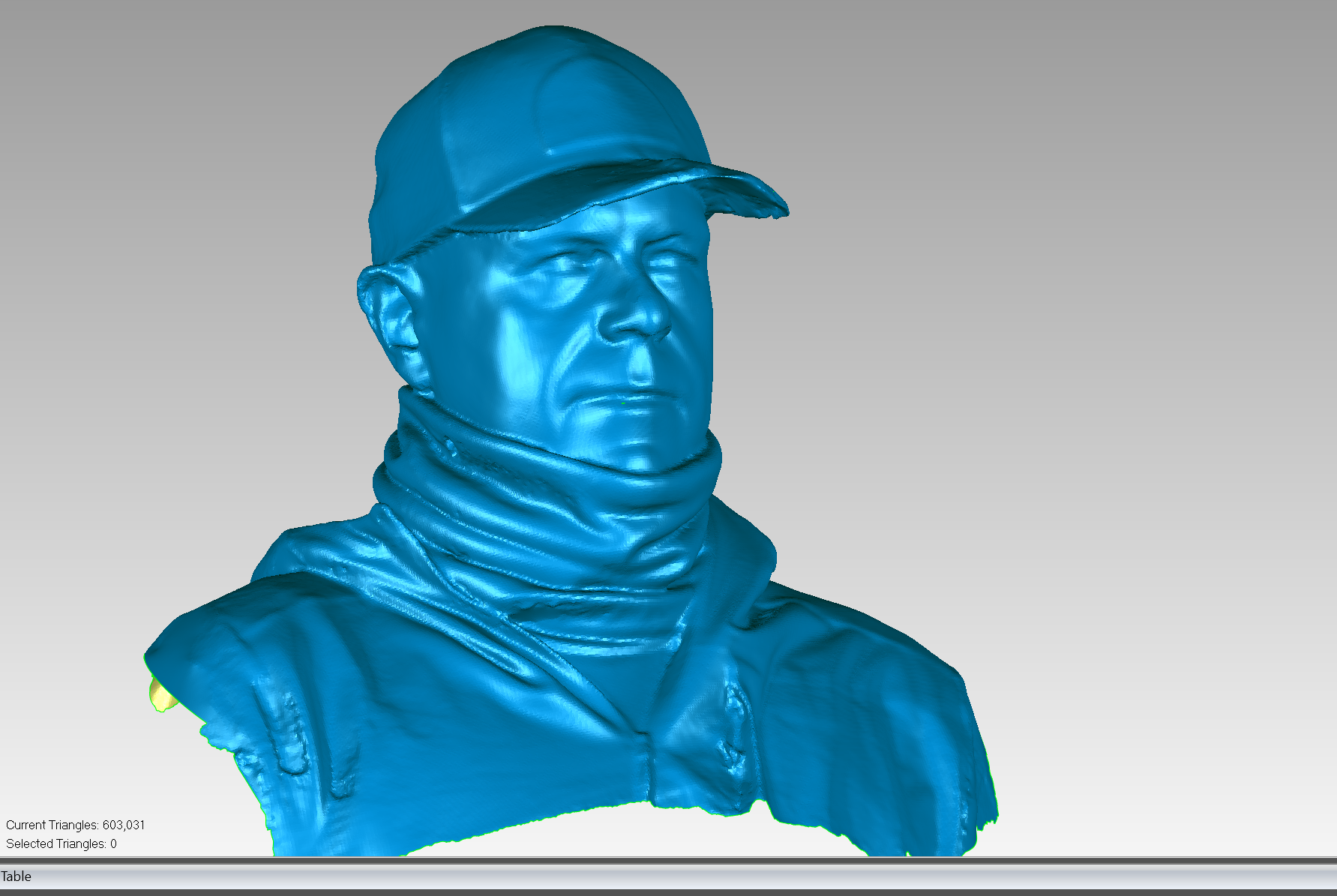
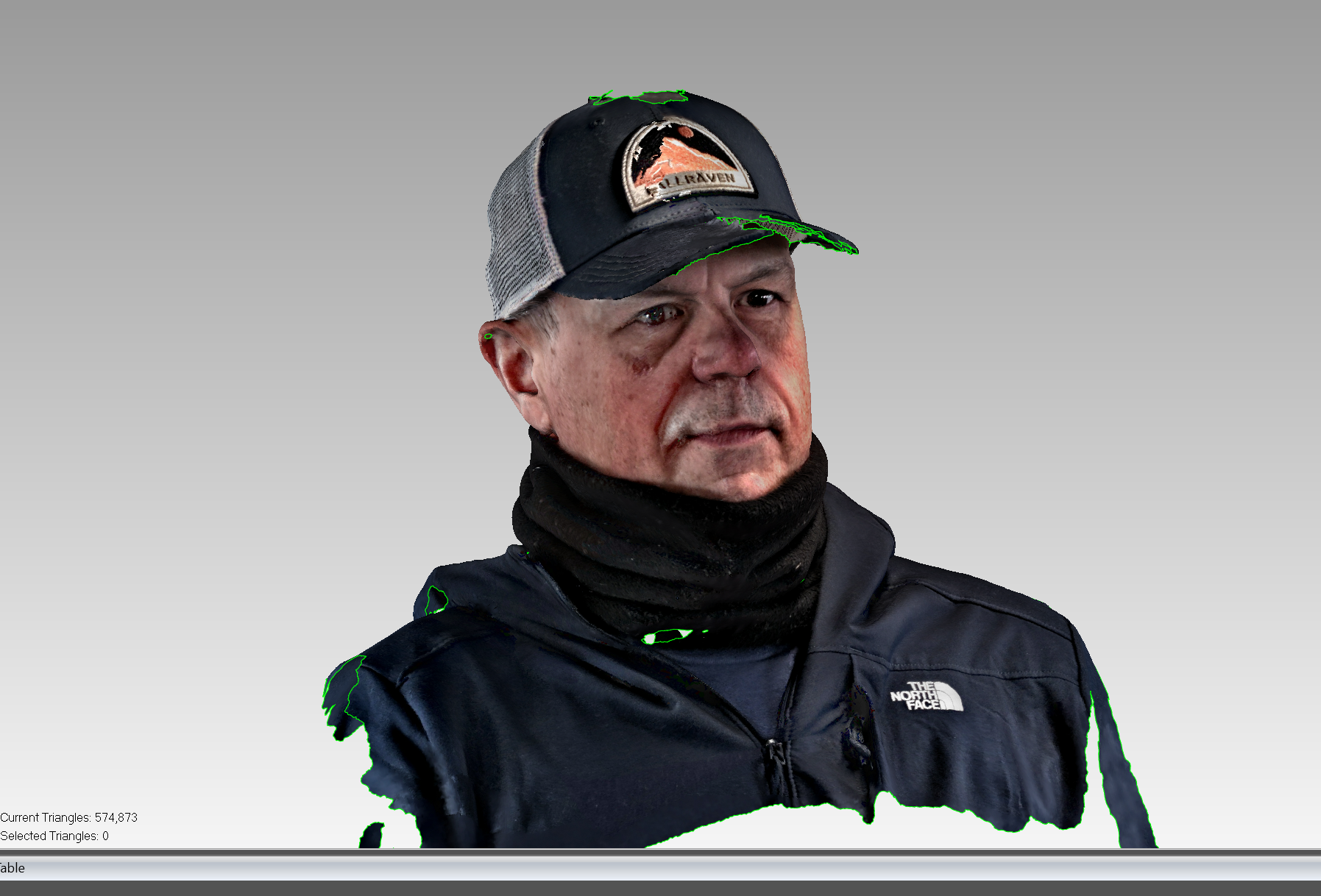
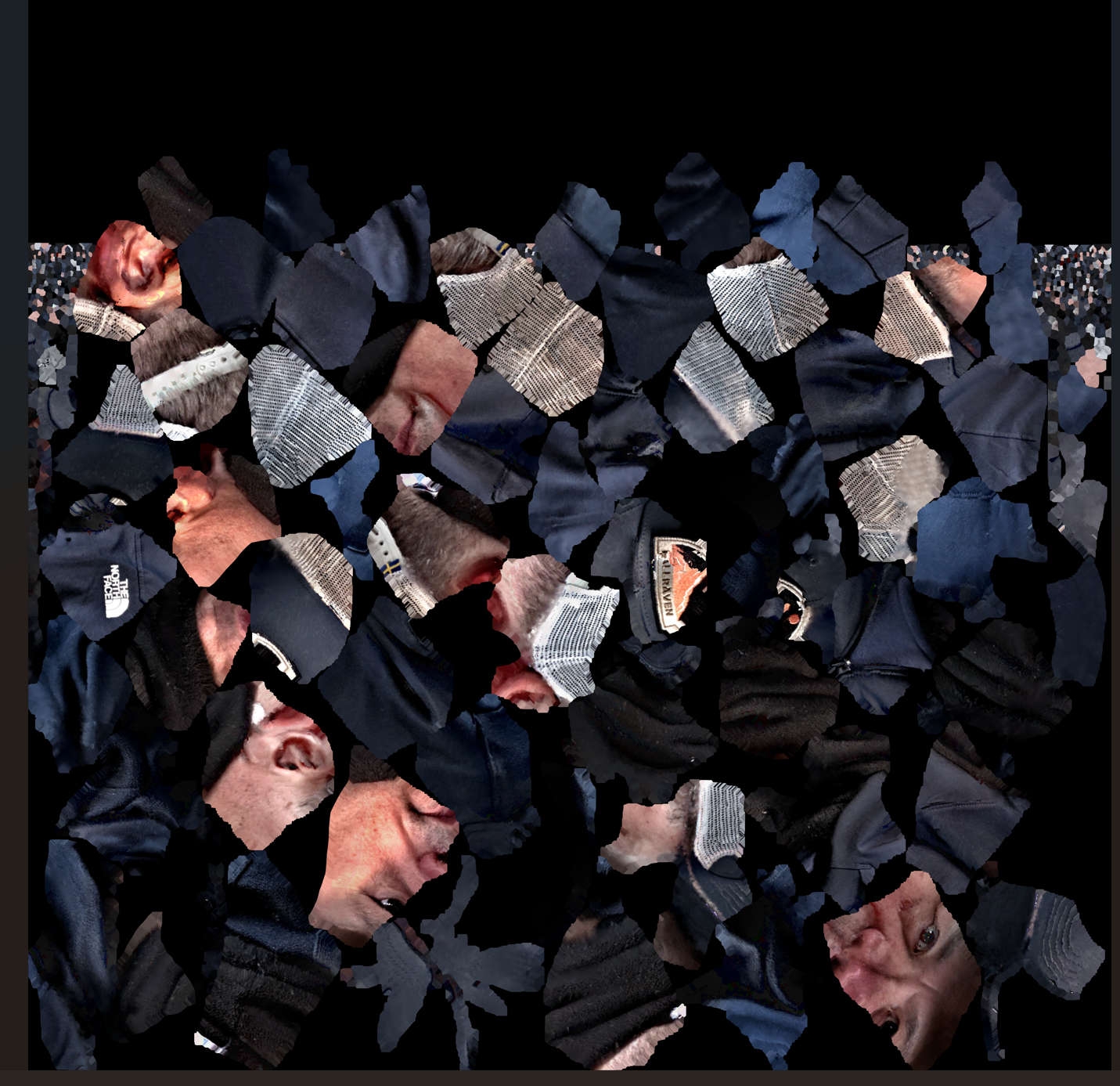
Then Ling-lin and I spent an hour with her scanner. She scanned my face and shoulders and the result is a bust of a man in a cap and a neck gaiter looking off to one side, six hundred thousand triangles, considerably more serious than I have ever been. Then the software unwrapped the texture and produced a page of my own face in pieces, an ear here, an eyebrow there, my jaw upside down in a corner, which is either an art project or a warning. I told her I wanted an action figure of myself. I have the file. If I ever meet somebody who makes video games, I am ready.
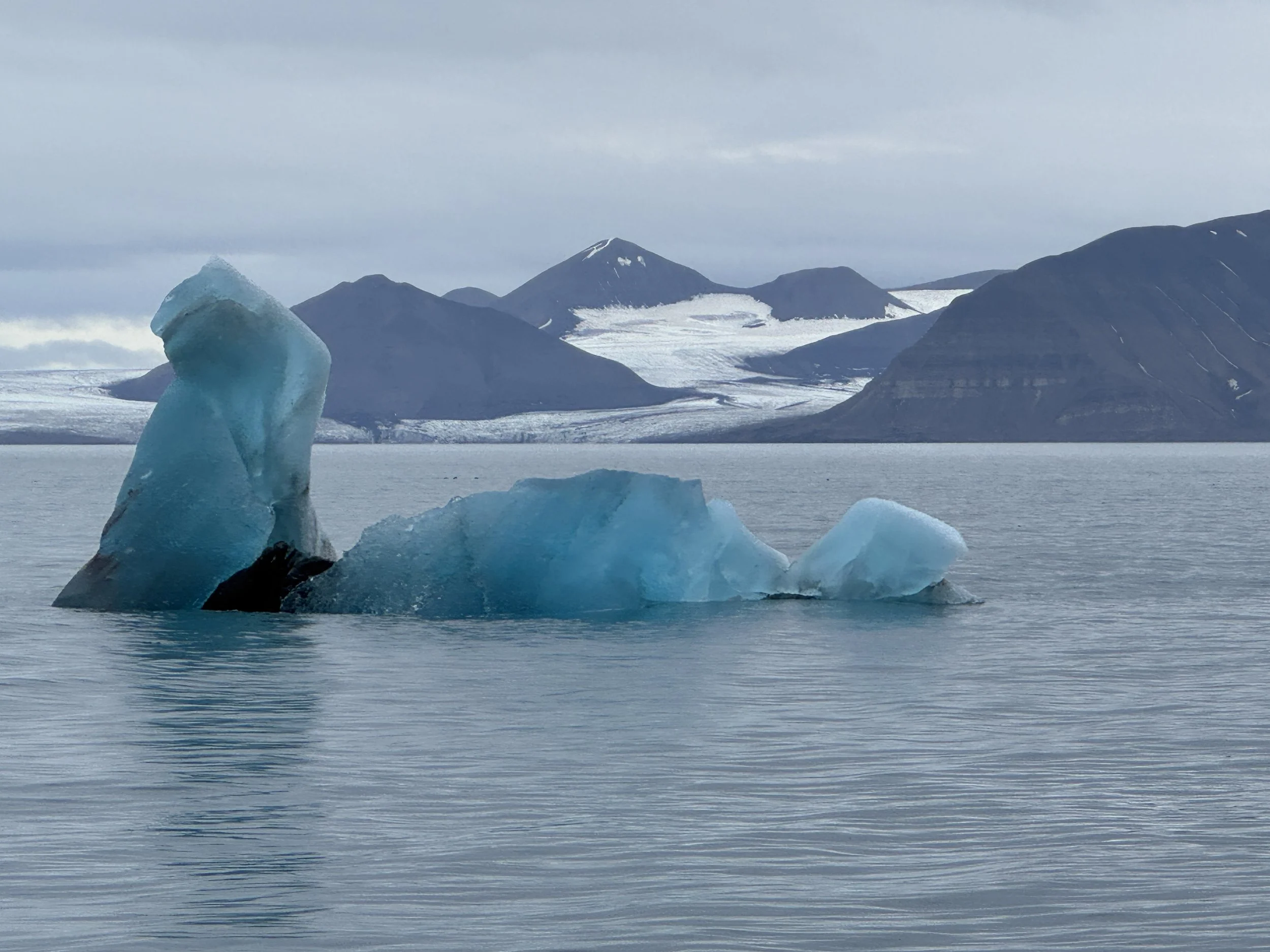
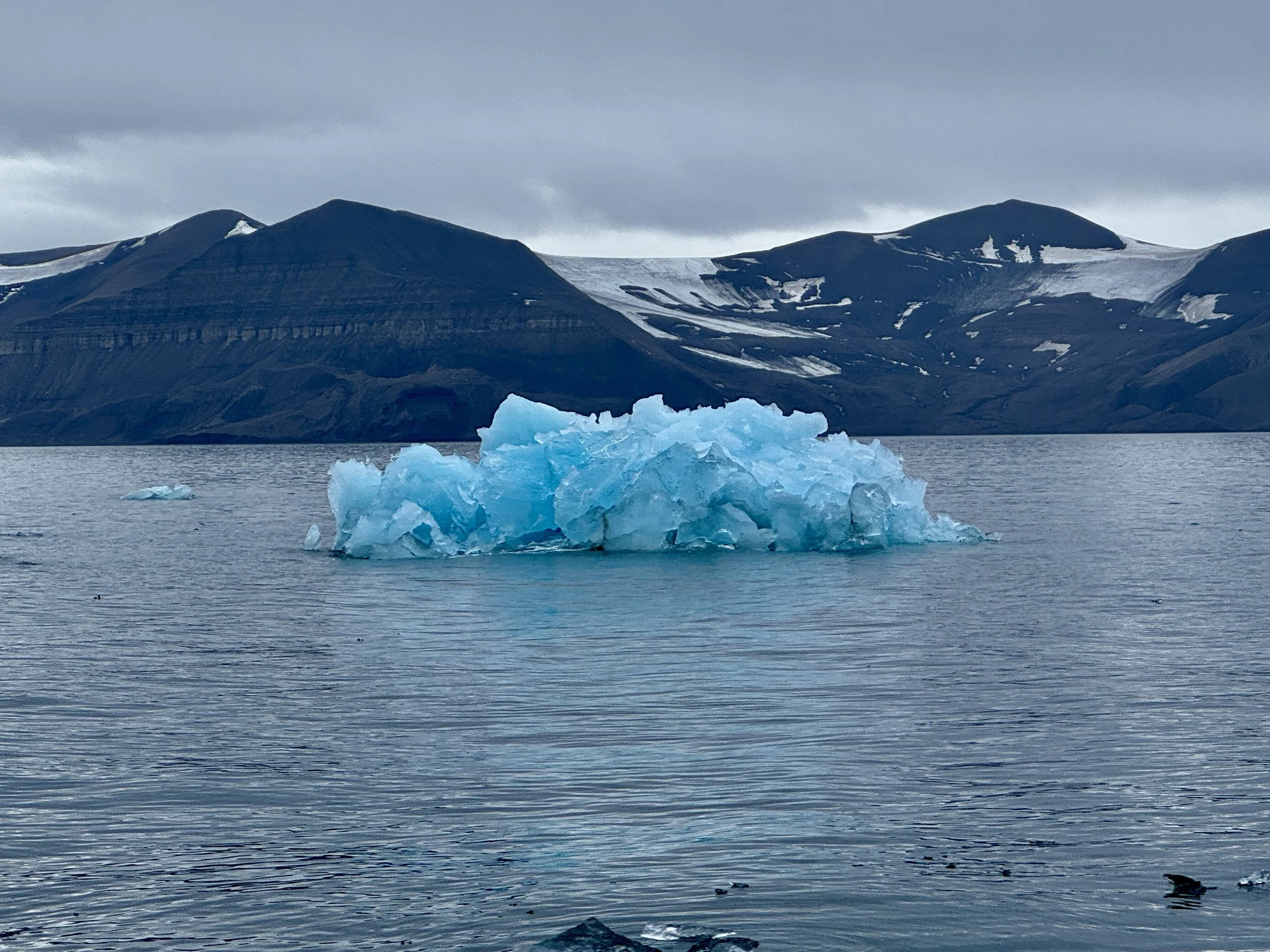
The icebergs came in the afternoon. Christina said they looked like sea monsters and I had thought exactly the same thing without either of us saying it first. One had a head and a long low back trailing behind it, unmistakably a creature crossing a loch, and the blue in them was not a colour I had seen before, not white with blue in it but blue the whole way through, like something lit from inside.
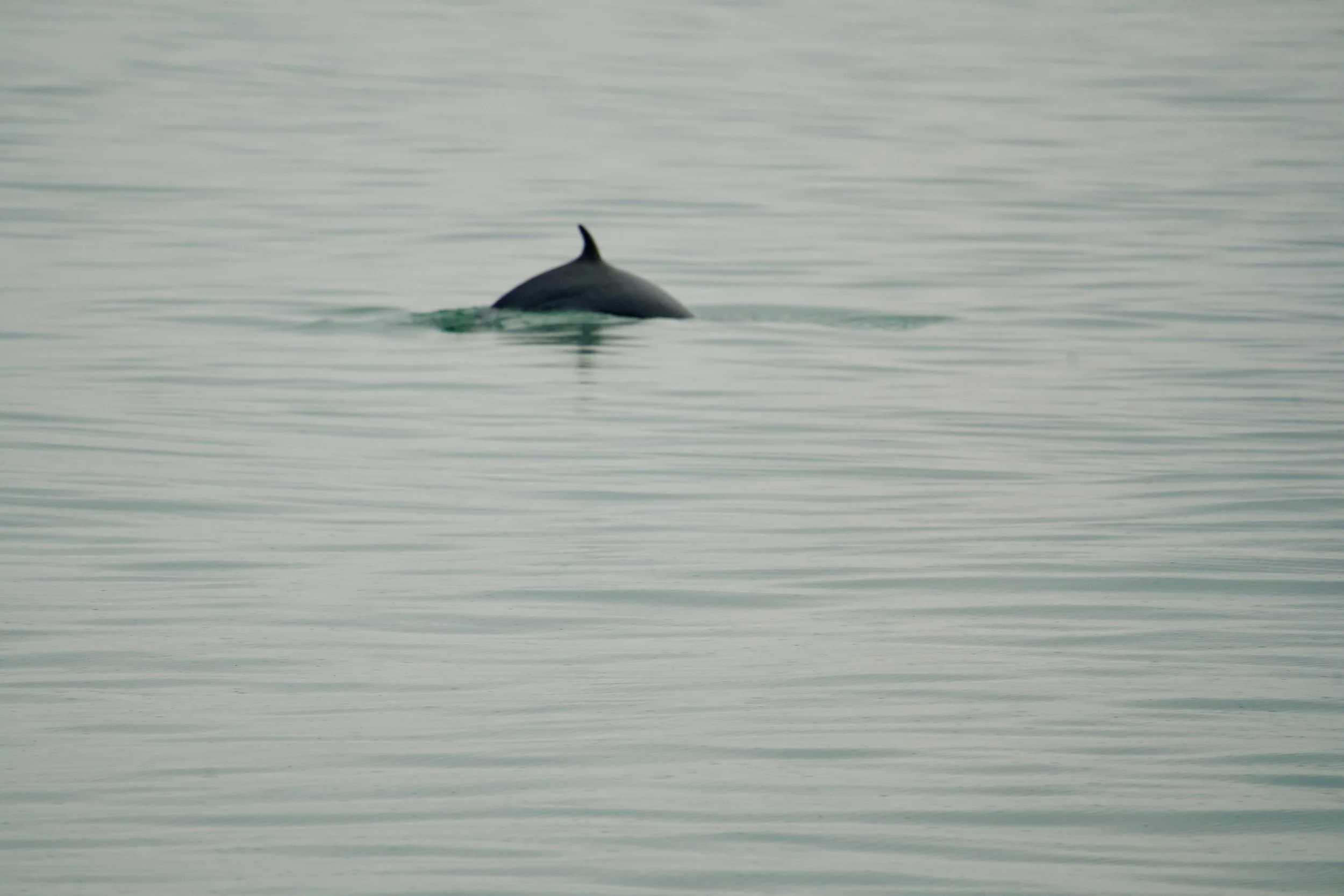
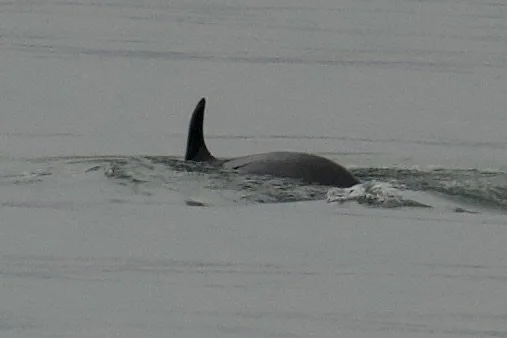
The minke whale came later. A dark back rolling up out of flat grey water and a small hooked fin and then nothing, and then it again somewhere else. I got one frame.
And then at the very end of a long overcast day Vicki came out onto the foredeck with a clarinet. I have not properly introduced her yet and this is the moment. Vicki Hallett is from Geelong in Australia and she is a musician and an acoustic ecologist and a field recordist, and her work is finding places with almost no human sound in them and listening to what is left. A ship carrying twenty-eight artists is not that place. She spent two weeks working around us, around the talking, around the shutters, around somebody opening a conversation two metres behind her at precisely the wrong second, and she never once made a point of it to anybody.
That evening she stood at the rail with the sails behind her and played, her hair going sideways in the wind. Nobody talked. A clarinet at seventy-seven degrees north, and the one time on the whole voyage that everybody gave her the air.
We anchored in Agardhbukta somewhere close to eleven, after seventy-seven kilometres, the longest day of the voyage. There was a beer at the bar. By then there always was.
I have been trying to work out why the ship days blur and the land days do not, and I think it is because on a ship day everything is recorded by somebody else. The captain explained the entire rig to me and I kept none of it. Sarah wrote down every sail and every minute and every degree of water temperature. Ling-lin's scanner kept my face at six hundred thousand triangles and kept the bear. Bob's photograph kept the exact angle of a tray of beans. Christina kept the Nutella. The compass kept 359.6. Everything about that day survives except my own account of it, which is thin as a receipt.
None of us knew what the next afternoon held. Ed was going to be standing at the rail at five o'clock in Mohnbukta looking at a stretch of moraine that had looked like nothing all day, and after five days of skulls and stones and prints and plastic and point clouds, there was finally going to be a bear in it.
“The least we can do is try to be there.”