Entry 045: Day 09: The Stones Go First
Thursday, 23 July 2026. Noorderlichtbukta, Straumslandet, Ormholet.
Breakfast ran a rotation of three for sixteen days and I ate none of it. Bacon and eggs, pancakes, hot dogs, round and round, while I stood at the bread with my butter and my jam like a man with a policy. I do not want savoury in the morning. I have not wanted savoury in the morning since I was old enough to have opinions about mornings. But some days there were pastries, small ones, little danishes and little croissants with something dark folded inside them, and those were presented to the room as chocolate croissants. They were not chocolate croissants. They had the shape of the argument and none of the evidence. The coffee machine was running the same operation one metre away. It offered a Wiener Melange, and what came out of it was coffee / hot cocoa doing an impression, and hot cocoa has no place anywhere near a Wiener Melange. Two counterfeit Viennese objects before eight in the morning, at seventy-eight degrees north, on a boat, in front of the one passenger equipped to press charges. I ate the croissant, and then, having committed to the direction, I went and got the Nutella and made the case properly on bread.
Then the morning briefing. Sarah went through the plan and then went back over the bears, because the day before we had watched three of them work a beach we had been standing on twenty minutes earlier. Joachim came in for this one, which he did not often do, and he told us how unusual that had been. A polar bear turning up at a landing happens about once every three years. He said it the way he says everything, no decoration, a number set down on the table.
Hold that number. It has about ninety minutes to live.
Sarah gave us three options, which she did most days. Stay at the landing site, take the middle walk, take the long walk. The long walk means no talking, no photographs and no questions, and it is genuinely for people who came here to move. I took the middle one, with Rosa, Ling-lin, Johanna, Maggie, Cathleen and Nadine, and both guides came with us, Sarah and Lisa.
The beach looked like nothing. I want to be honest about that, because it was the second time in nine days that a place looked like nothing and then opened up under my feet. We had barely stepped off the boats when the ground turned out to be full of dead animals. Two minutes ashore and I was on my knees over a coiled spiral the size of my palm, set into pale sandstone, the outer whorl broad and the inner coils winding down to a point. Six seconds later I had the second one, a dark segmented line with fine ribbing flaring out at the top of it. I am not a stone man. I could not tell you what either of them was and I am not going to borrow a name for them from somebody who could. What I can tell you is that at a quarter to ten in the morning the first thing that place handed me was an animal that had been sitting in the rock since long before there was anybody around to be impressed by it.
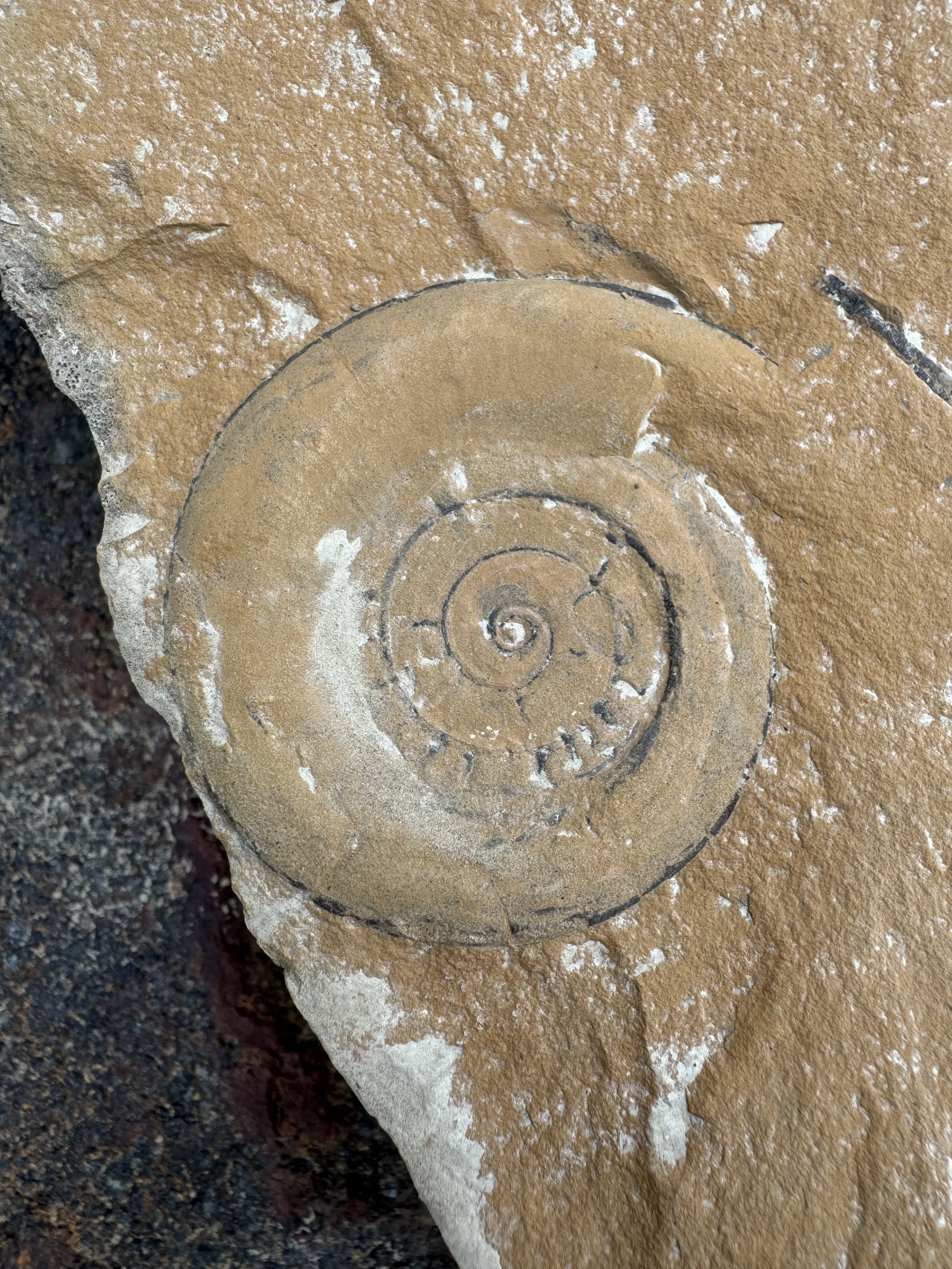
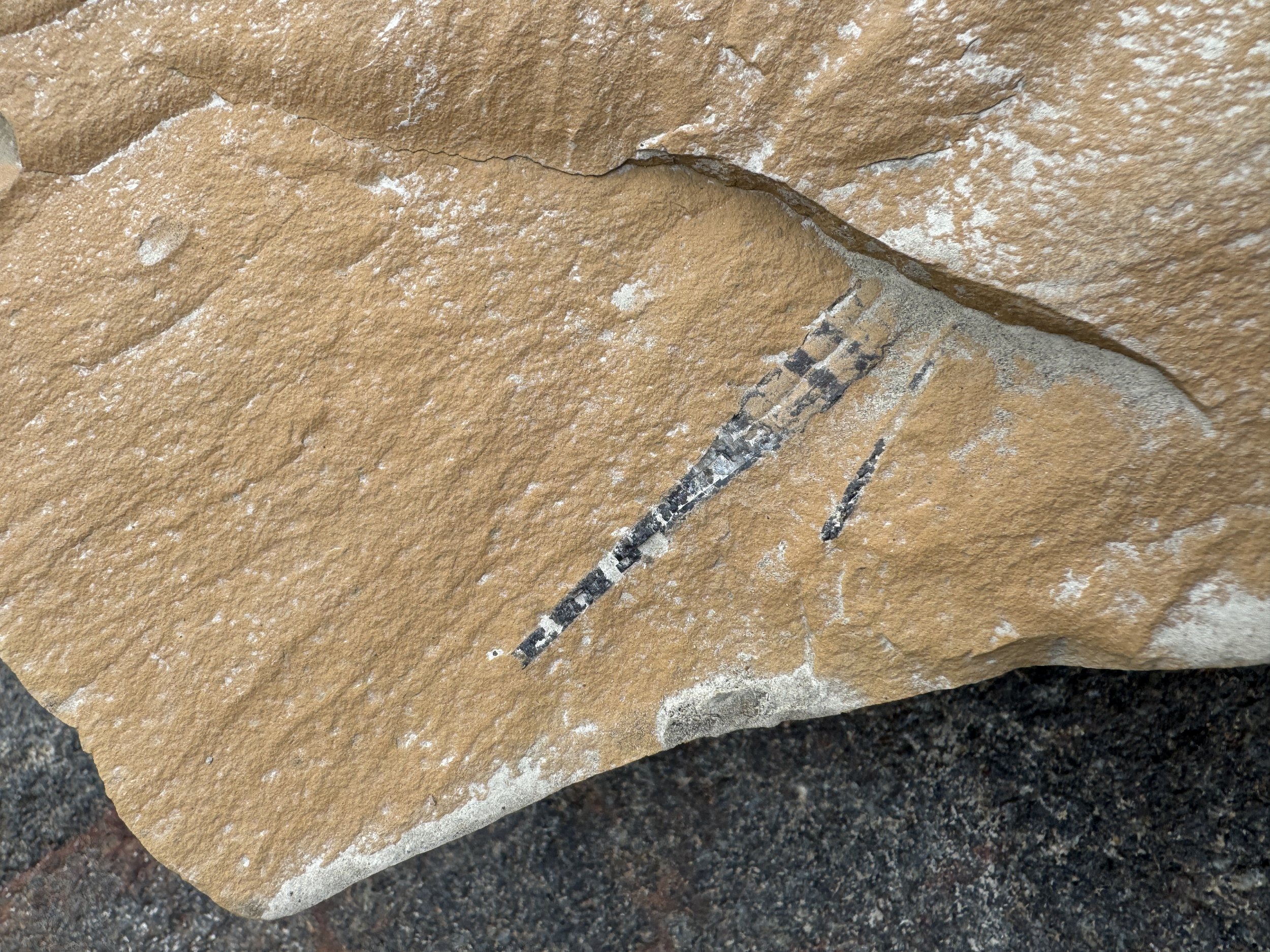
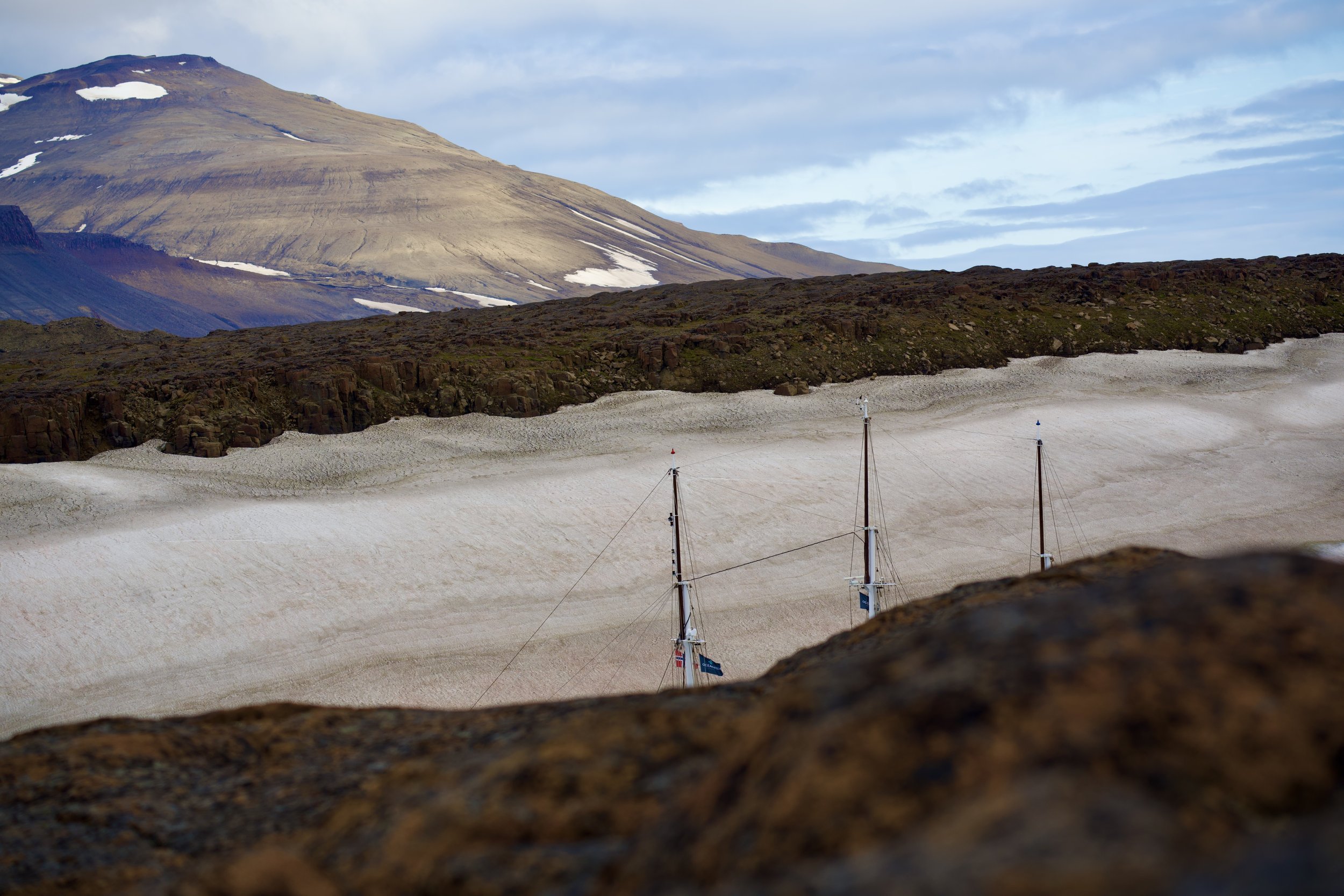
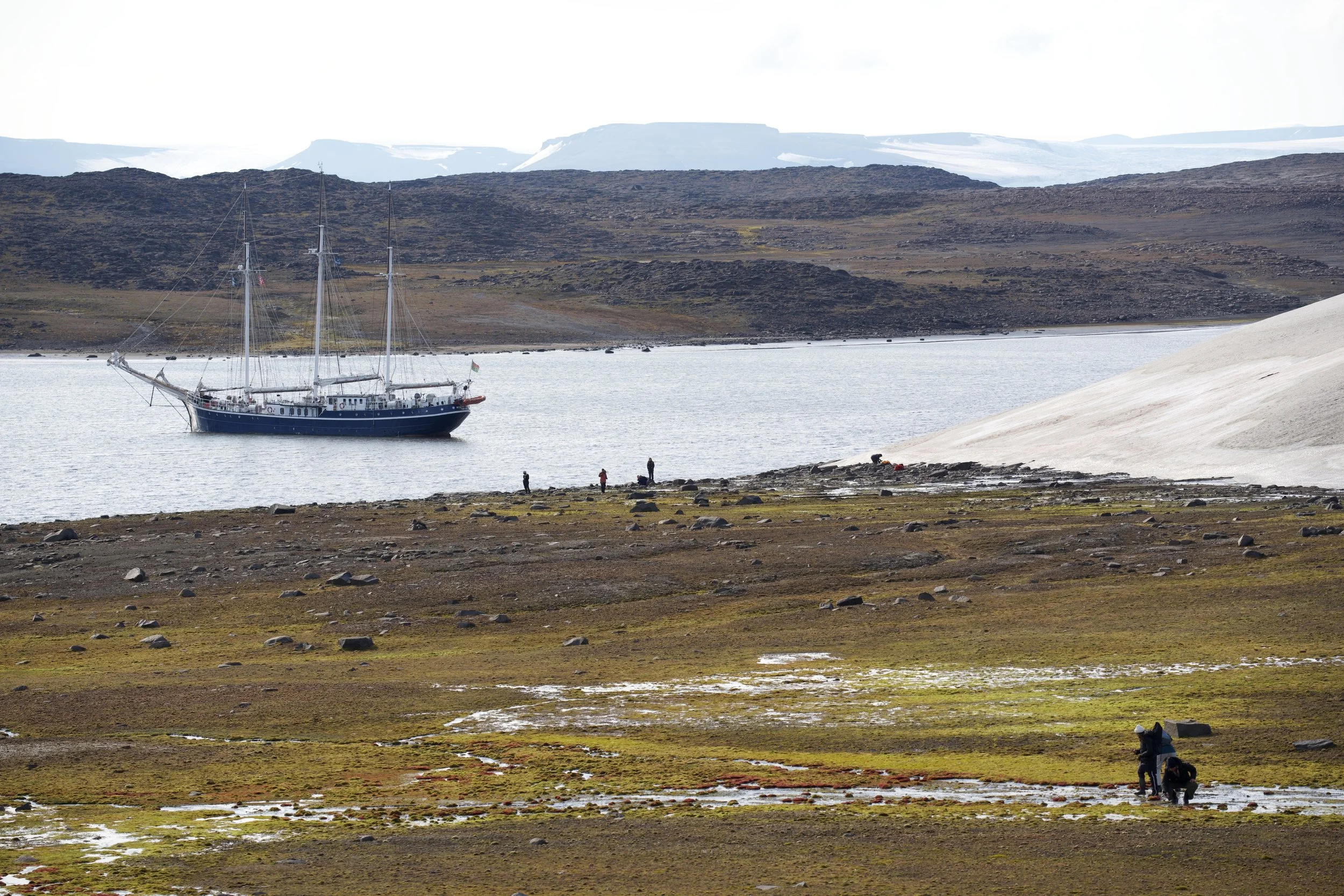
Then up. The climb out of that beach gives you one of the best views of the whole voyage and it does it by taking almost everything away. You come over the rise and the ship is gone. What is left is a long white sweep of old snow, brown rock above it, and three thin masts standing out of the middle of all that white with no hull under them at all. Forty-nine metres of steel reduced to three lines and a flag.
We looked back before we went on and there they were, the Famous Five, out on a rise a long way off. Heidi, Gergő, Eleanor, Julia and Beth. They were specks. I put five hundred millimetres on them and got the frame, and I remember thinking better you than me, because the long walks are long in a way the word does not cover. Gergő went on most of them. It had settled into a routine between us where the middle walk got back first, so I would be showered and dressed by the time he came through the cabin door looking pleased and destroyed.
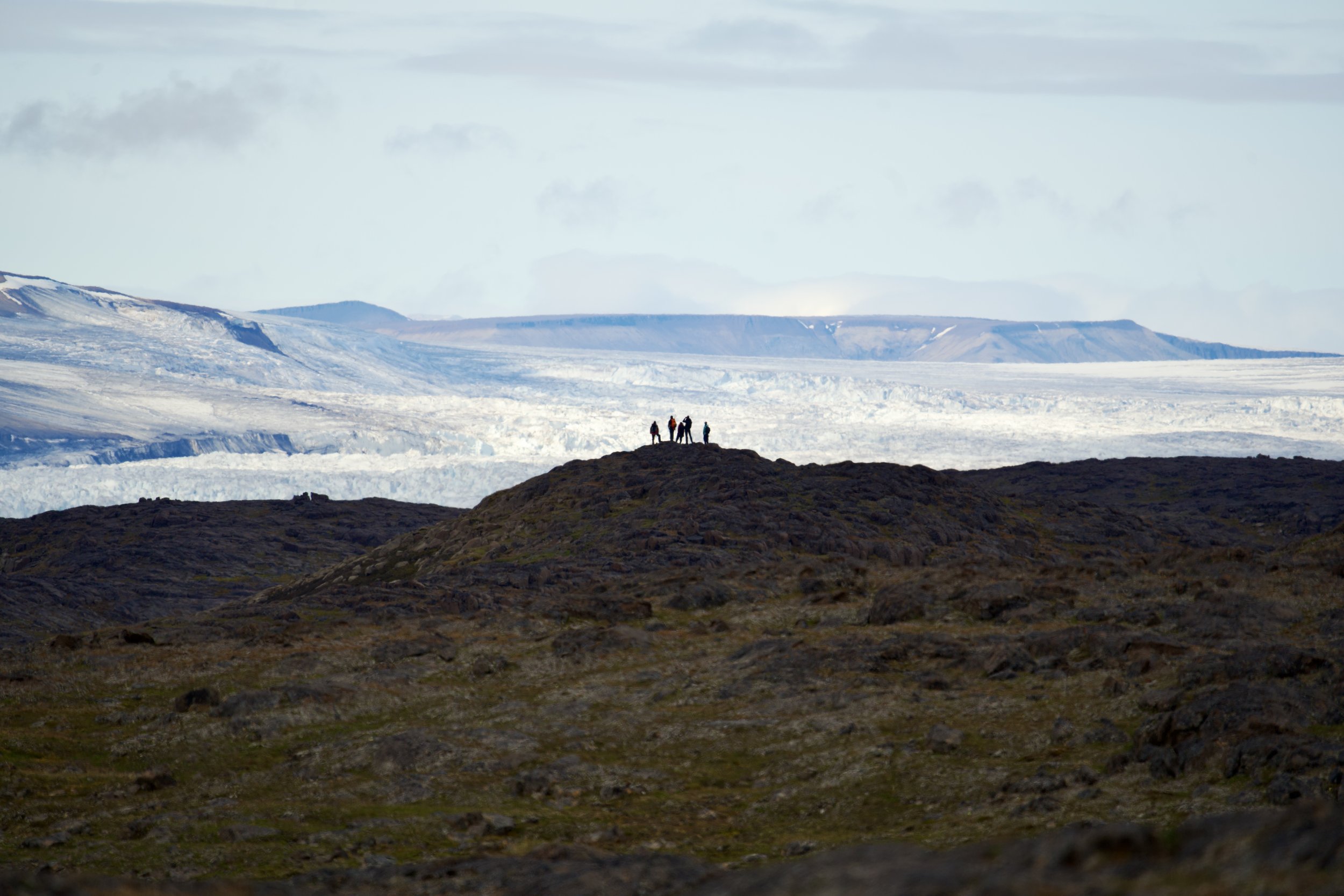
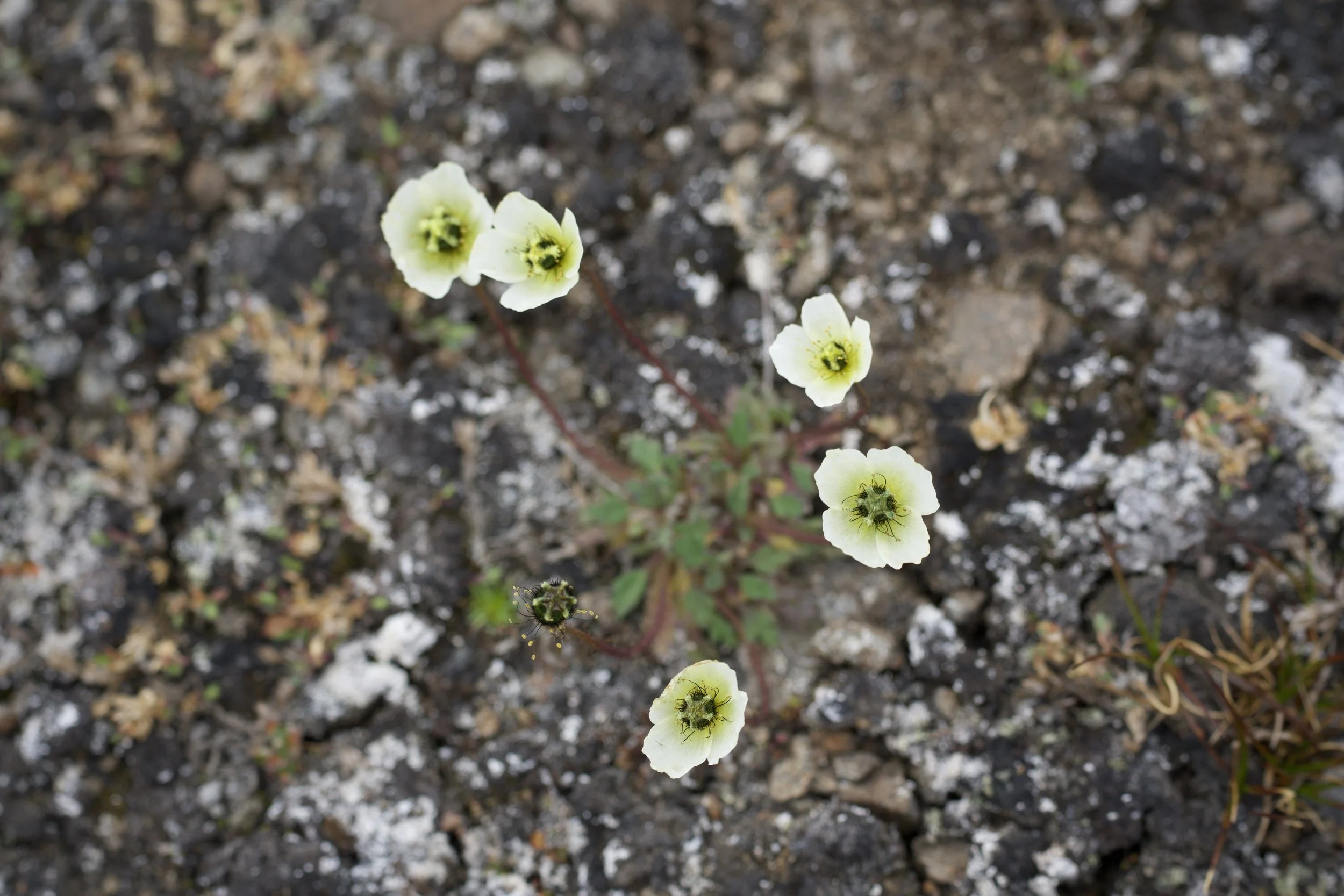
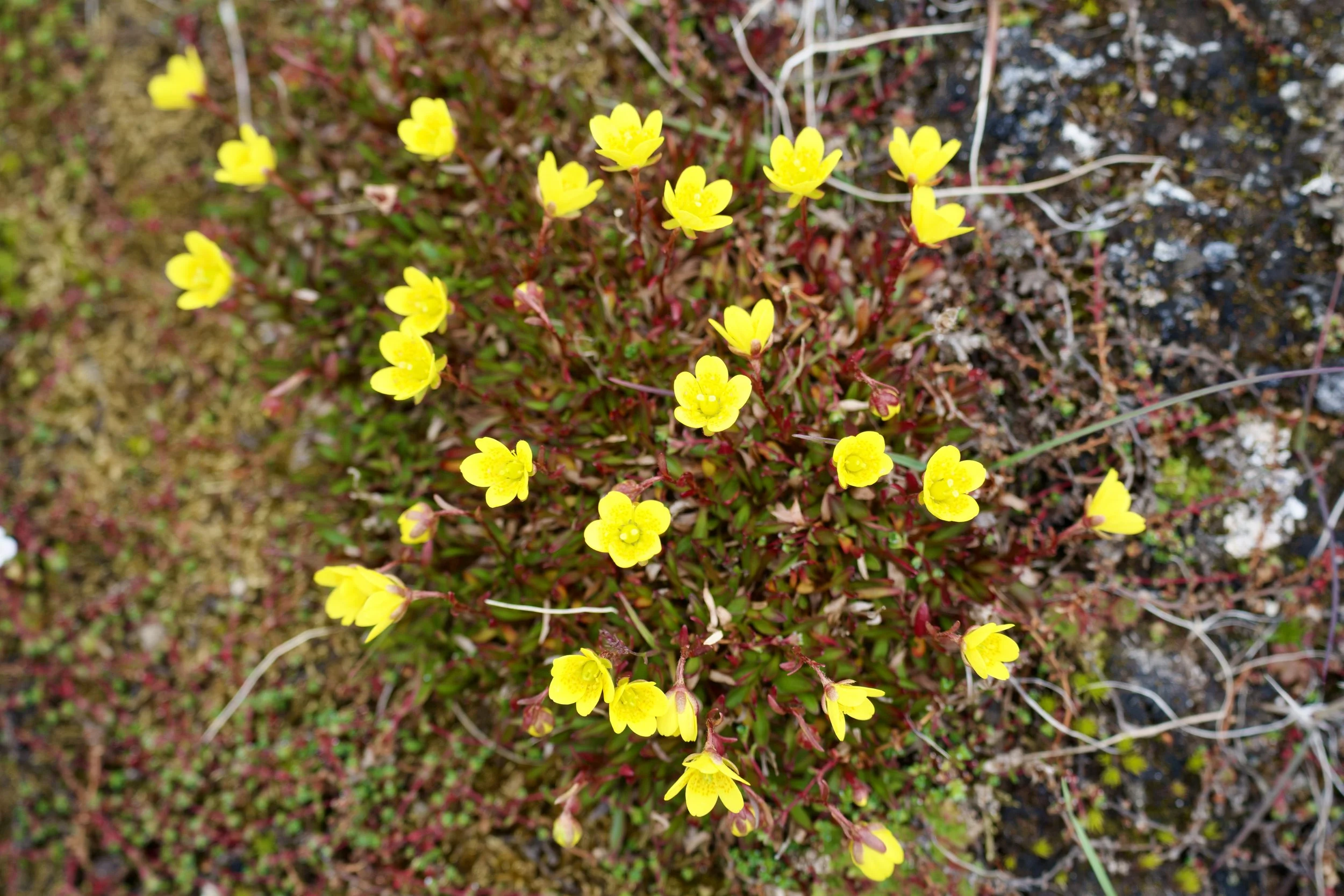
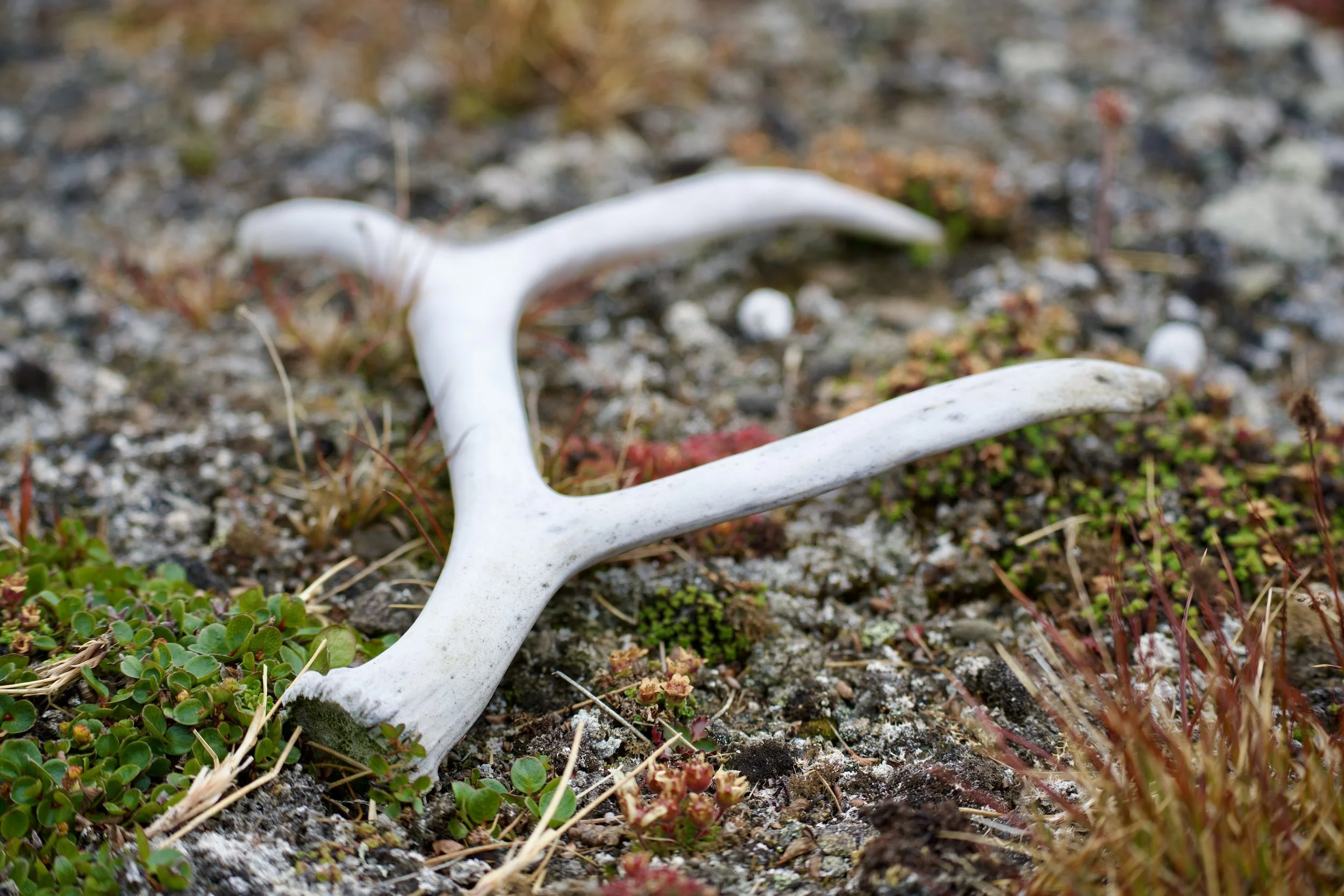
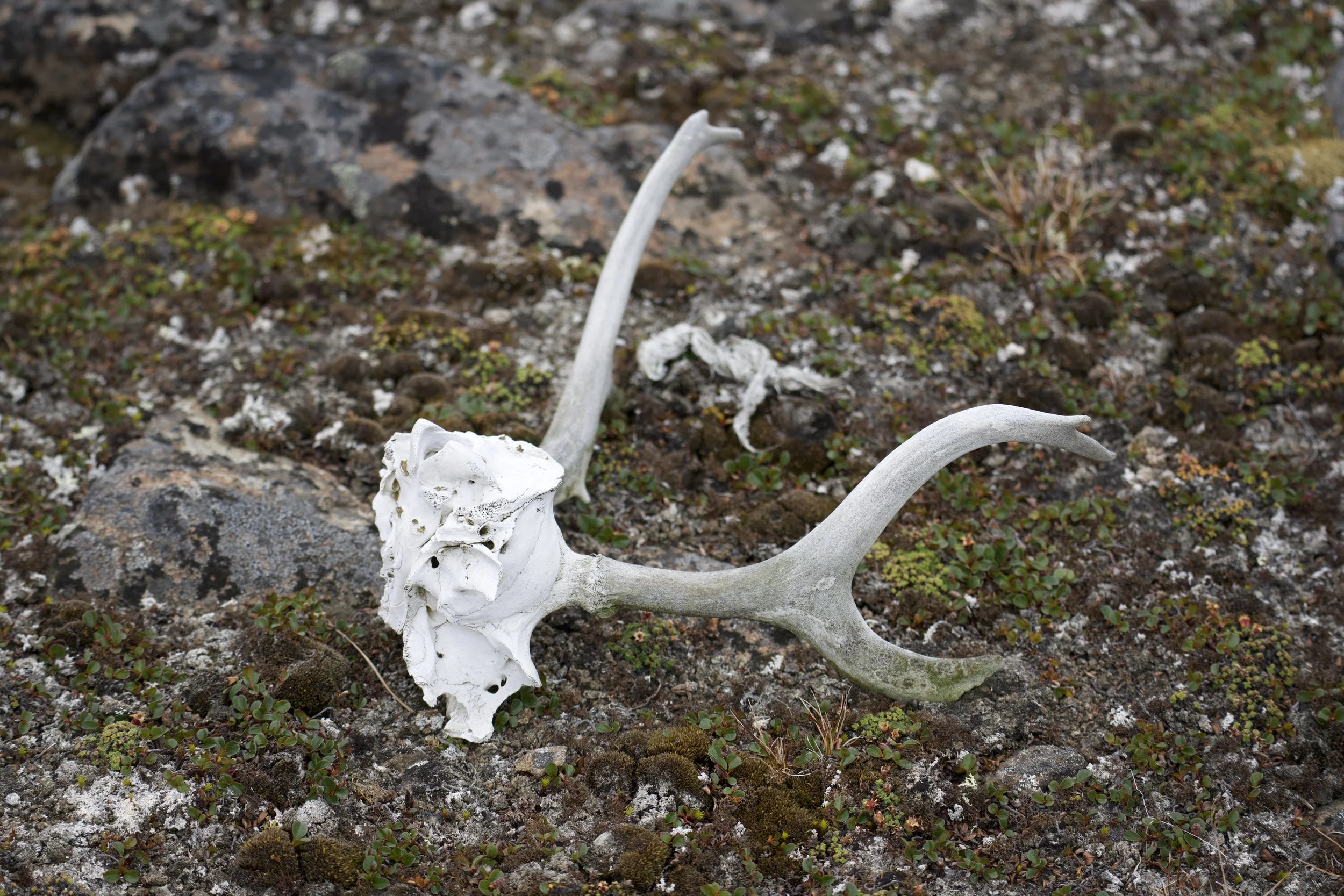
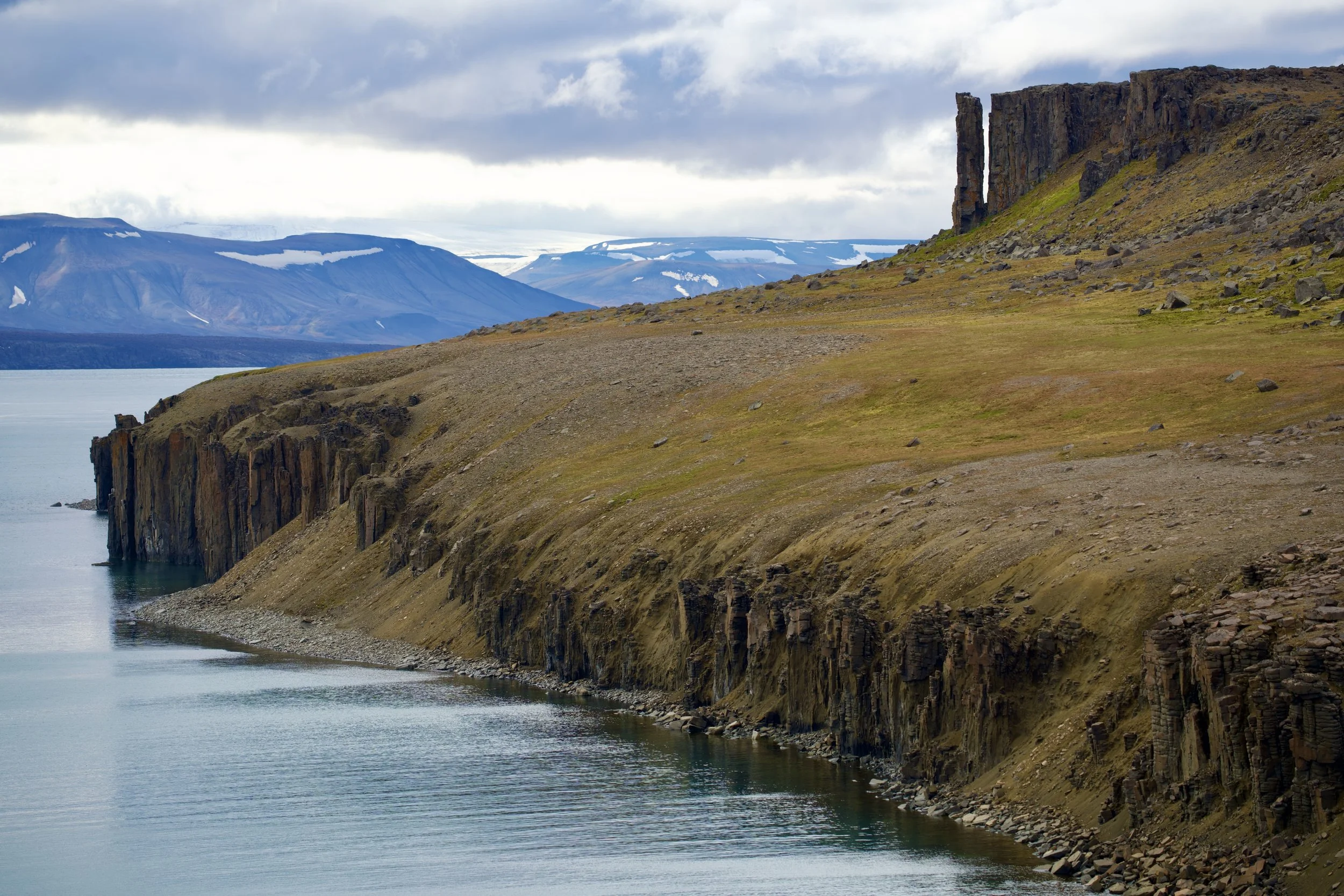
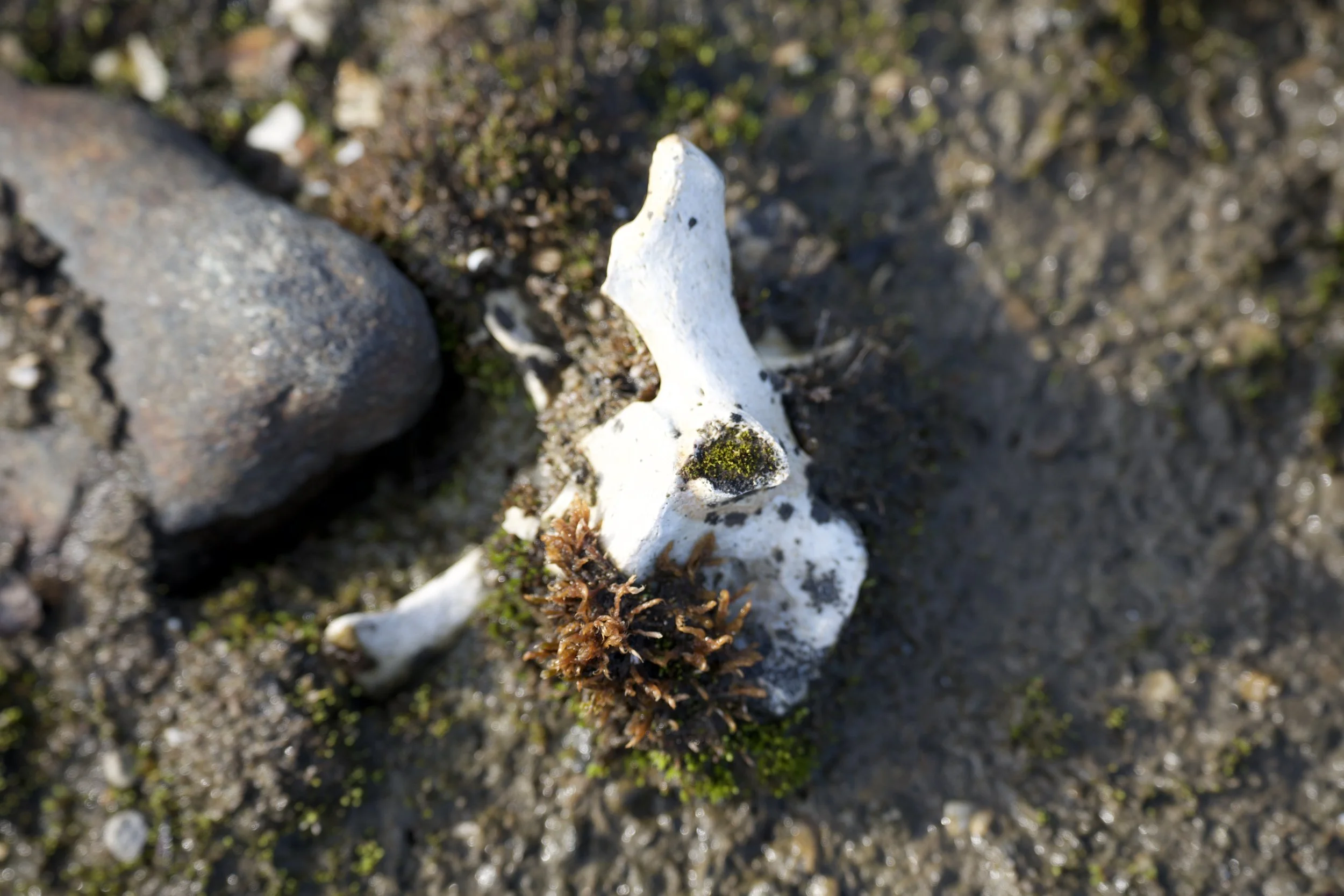
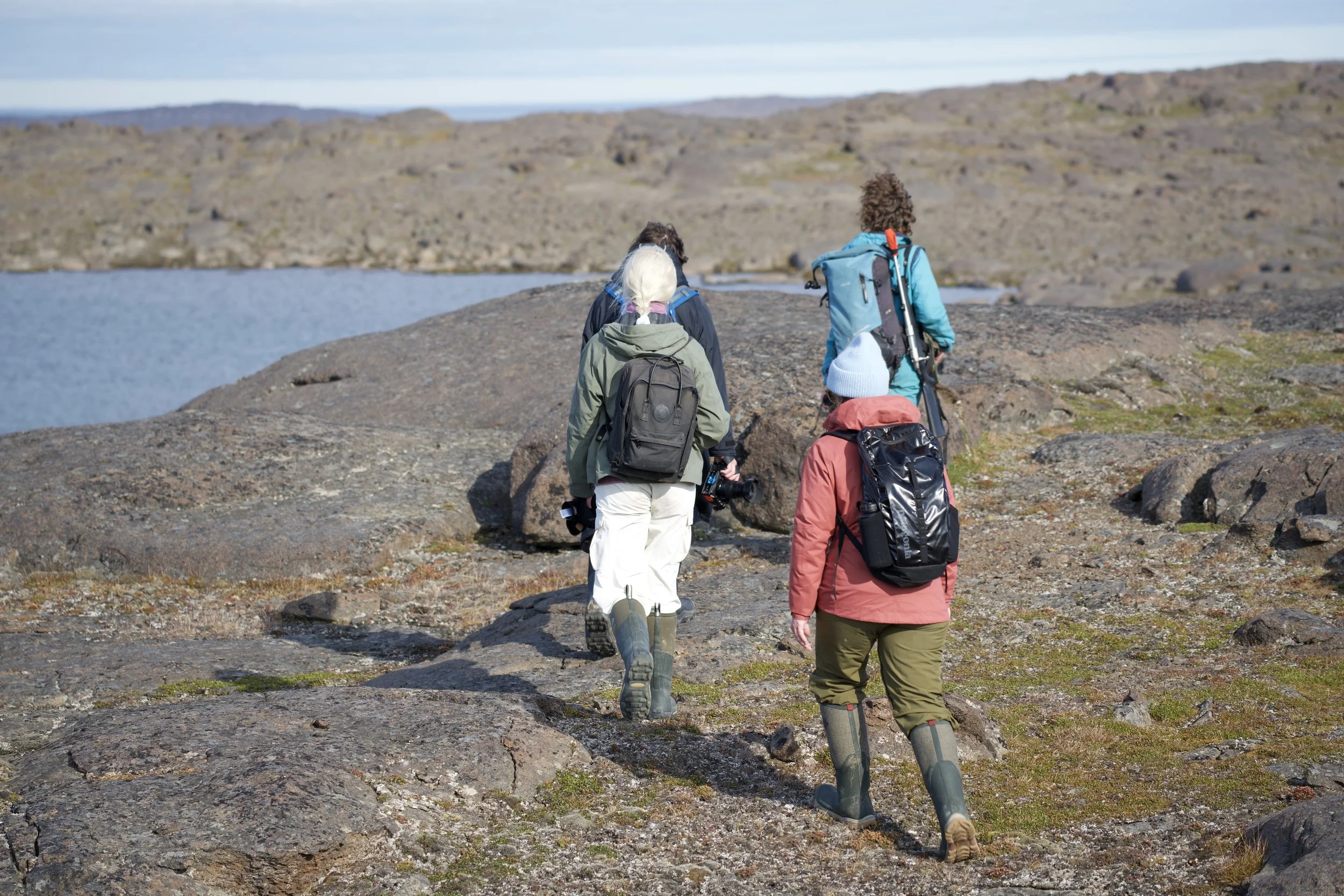
The hike was beautiful and it kept being beautiful. Mossy in places, green and soft in a way that put me back in the Alps, and then it opened into rock terraces stacked above water and I was somewhere between the Badlands and a smaller, colder Grand Canyon. Antlers lying where the animal left them. A skull with both beams still attached. Flowers coming up out of bare gravel, white ones first and then a yellow cushion of them, holding on in a place that offers them nothing. Nobody touches any of it. By the ninth day that has stopped being a rule and become the way you behave.
And then I found the stone.
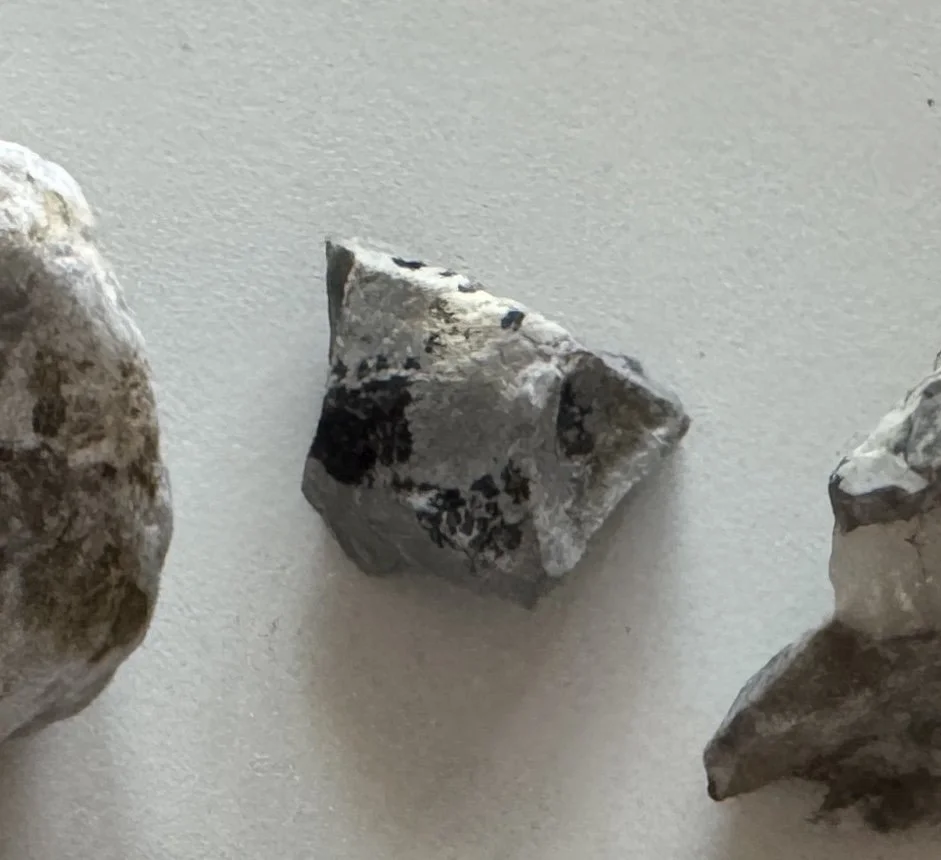
The stone shows two bear paw prints (I thought)
Grey, palm sized, and pressed into the face of it a dark mark with toes on it. A paw print. Not a bear. A bear's foot, which is a different thing, and that difference took me until California to understand. On the twenty-second I found a bear in a rock and a bear came out of the water. Later that same day I found a seal in a rock and a seal went by on a floe. Standing on that hill with a print in my hand I had the first clear thought of the sequence. Wait a minute. Are we going to see a bear?
We sat down on a big rock and stayed twenty or thirty minutes. Windy but not cold. Some people wrote, some sketched, I took photographs and then stopped taking them and put my head back and let the whole thing in.
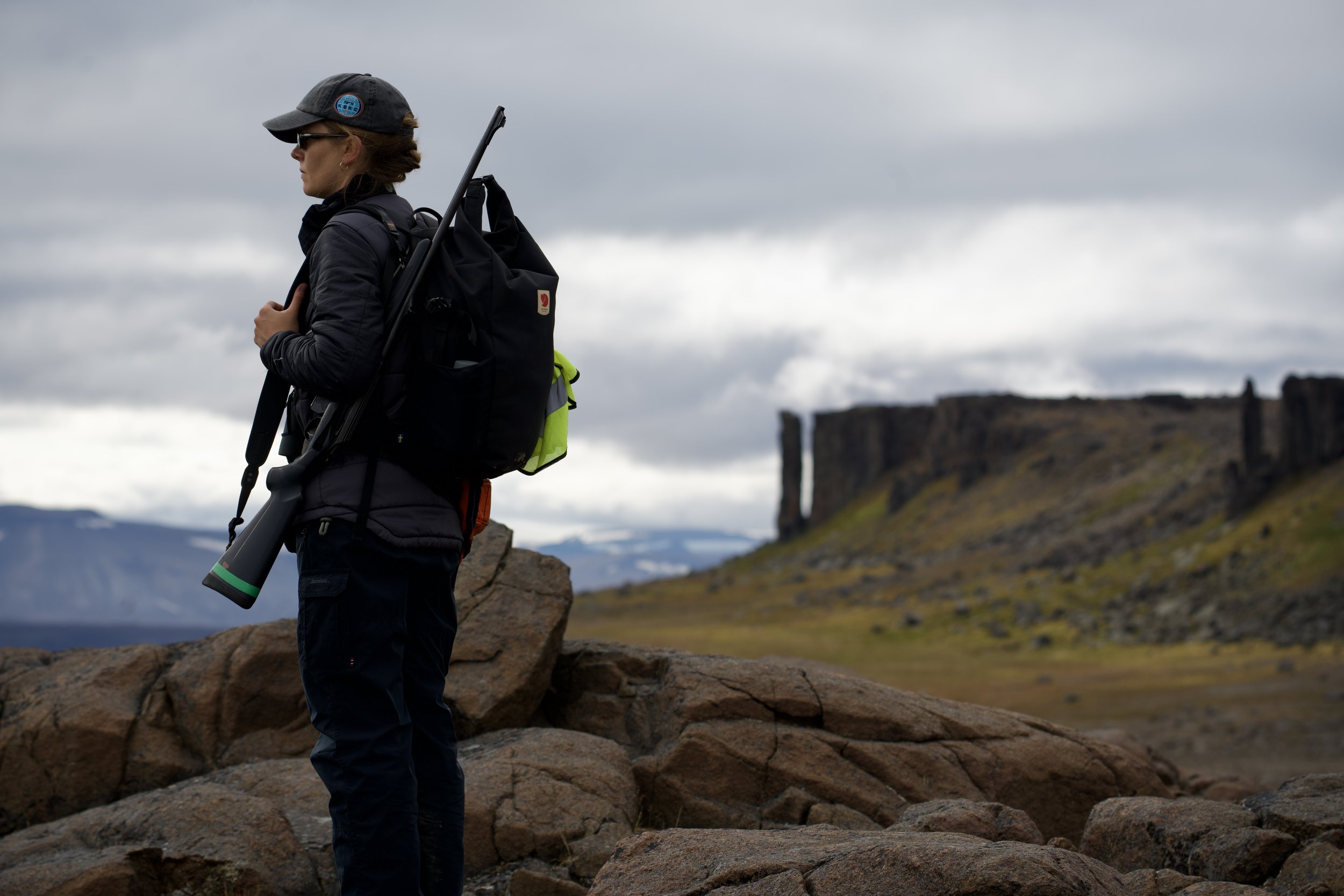
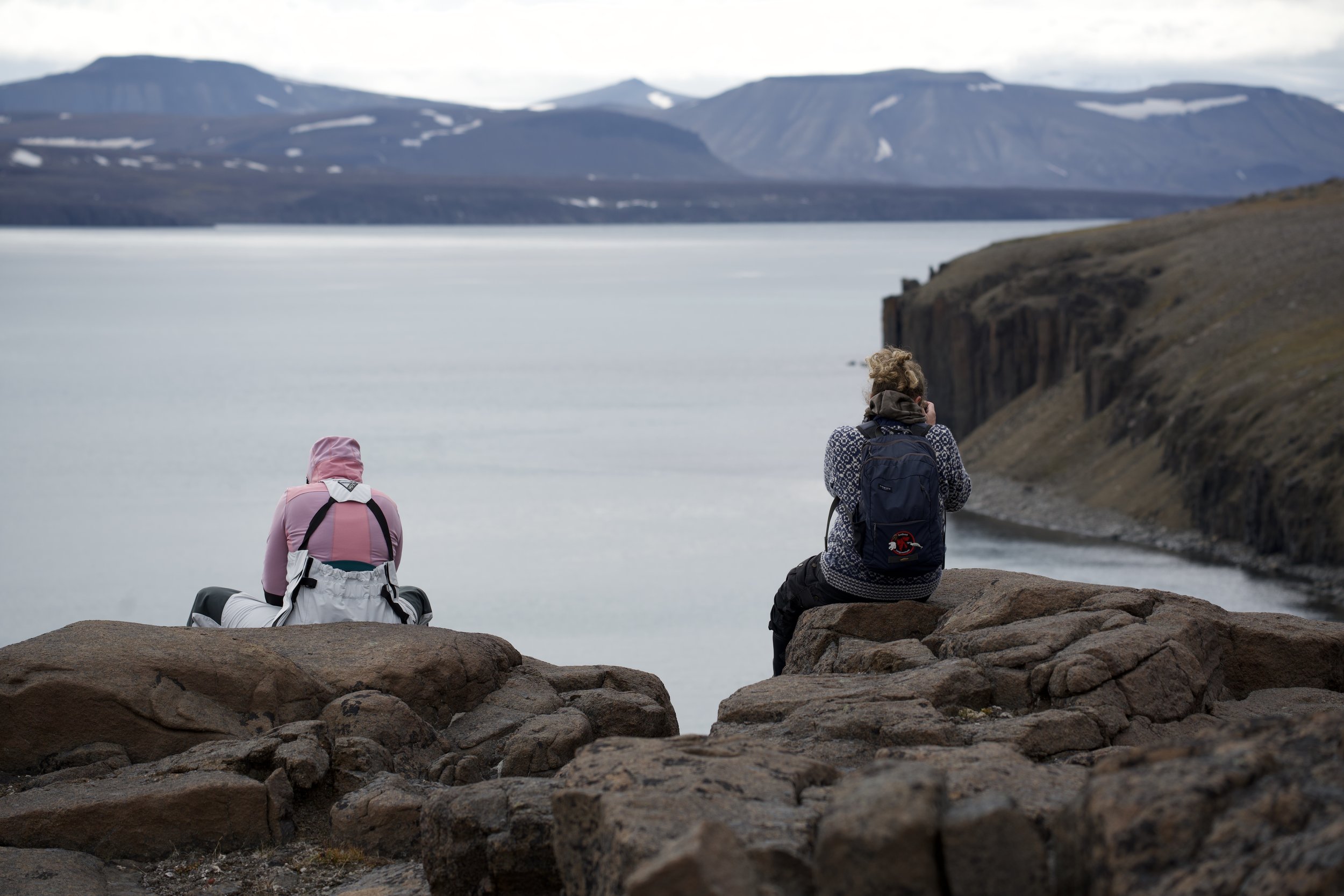
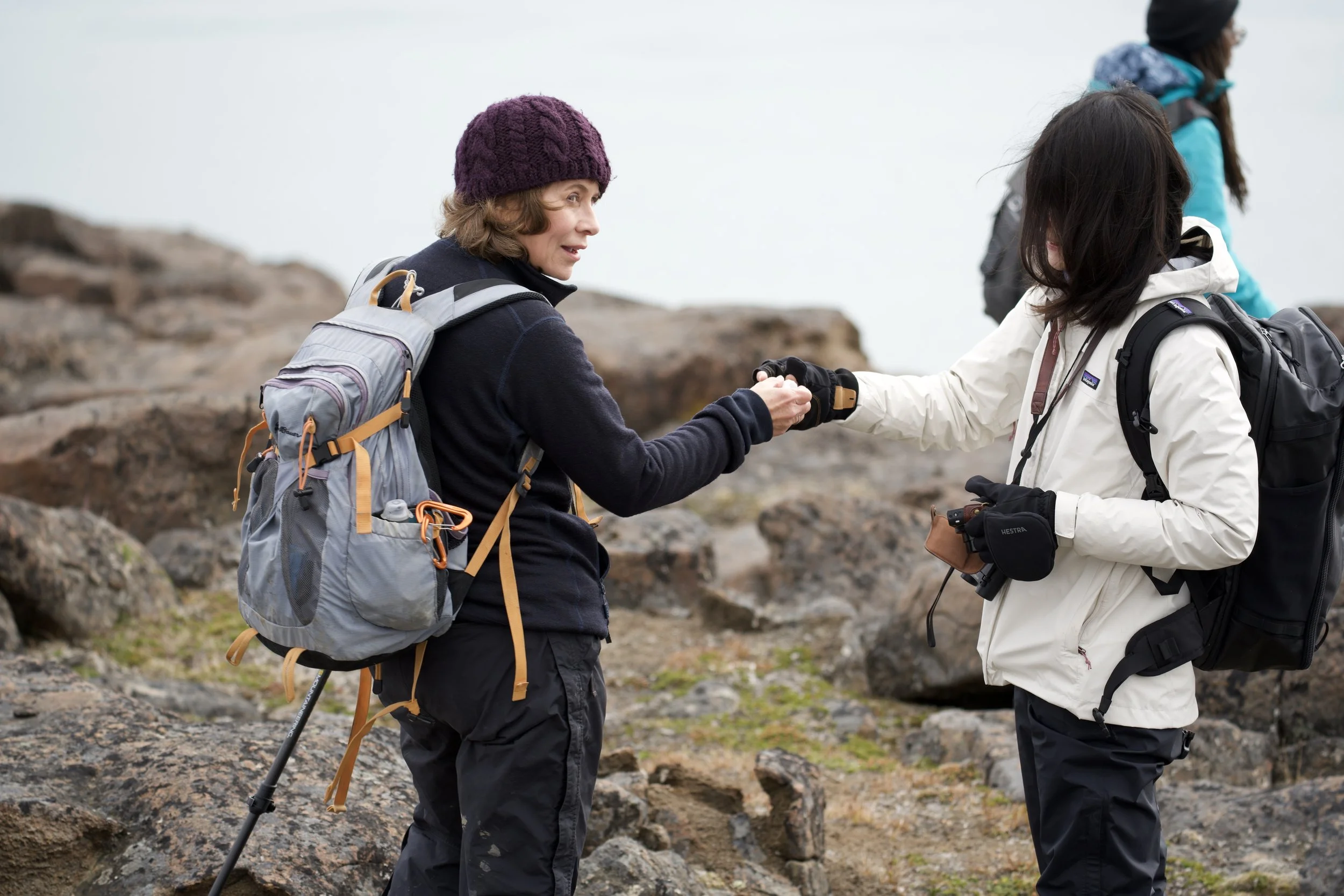
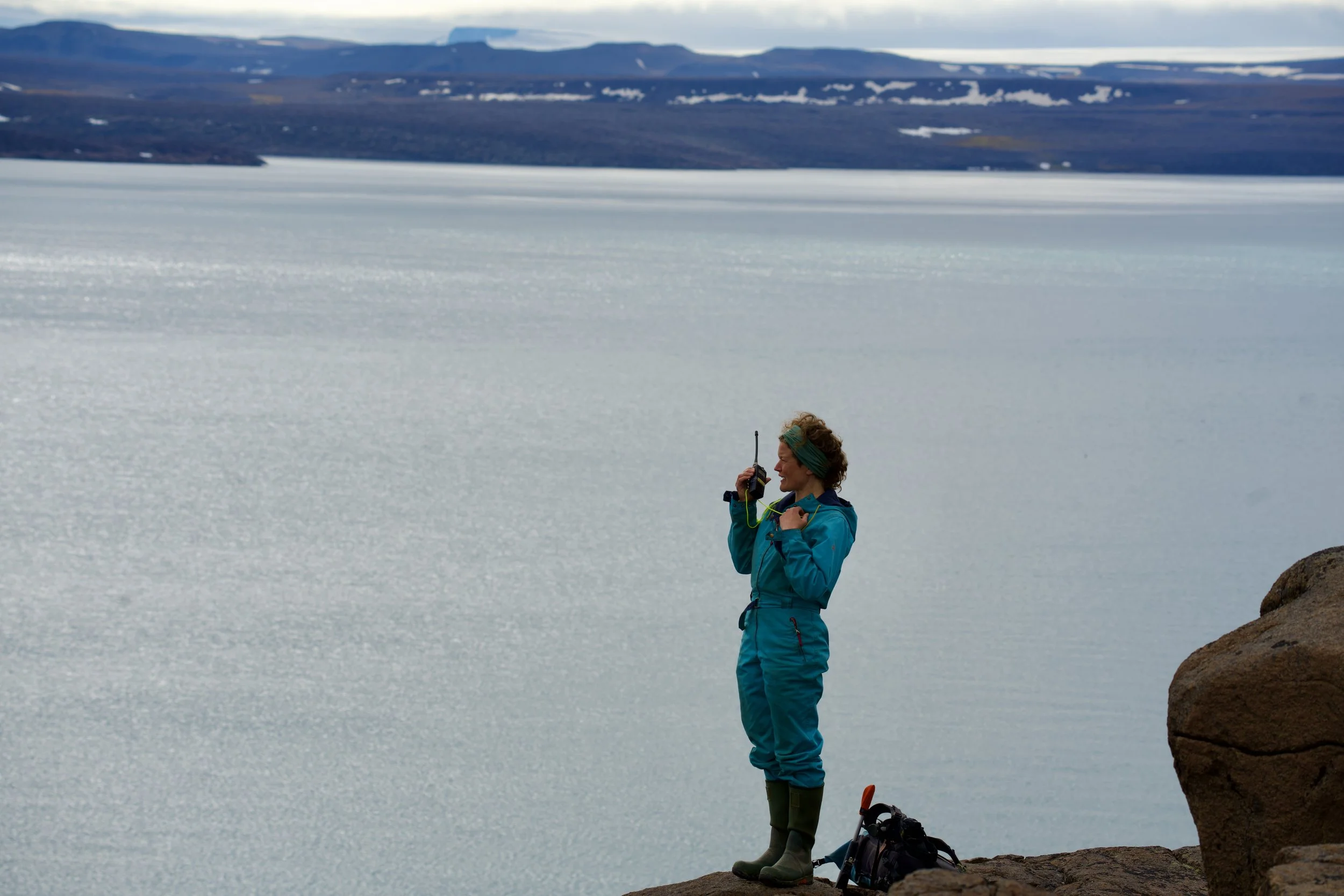
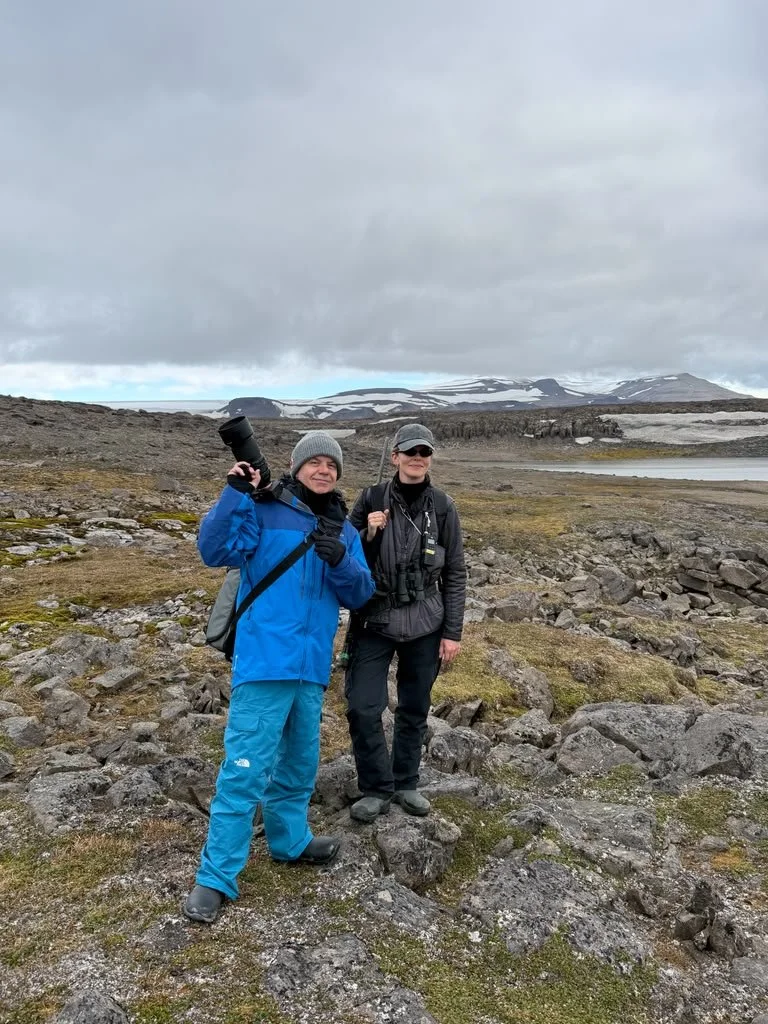
Somewhere in there we heard a shot.
Nobody thought anything of it. Later, at the table, everyone had a theory. A hunter somewhere. Ice coming off a front. Sound doing what sound does over water. I had no theory. I registered it and filed it under nothing, because the idea that a person within earshot might be firing something did not enter my head.
We came down the same way we had gone up. Another antler. A last wide frame of the terraces. We were close to the point where the path turns down toward the beach and I had not yet seen the three masts come back, and Sarah's radio came on. It was Beth. Hard to hear at first, and then one word out of it. Bear. She did not sound rattled. She sounded like somebody reading out a fact she had already dealt with. They had encountered bears, they were heading back, everyone was moving, everyone was ok.
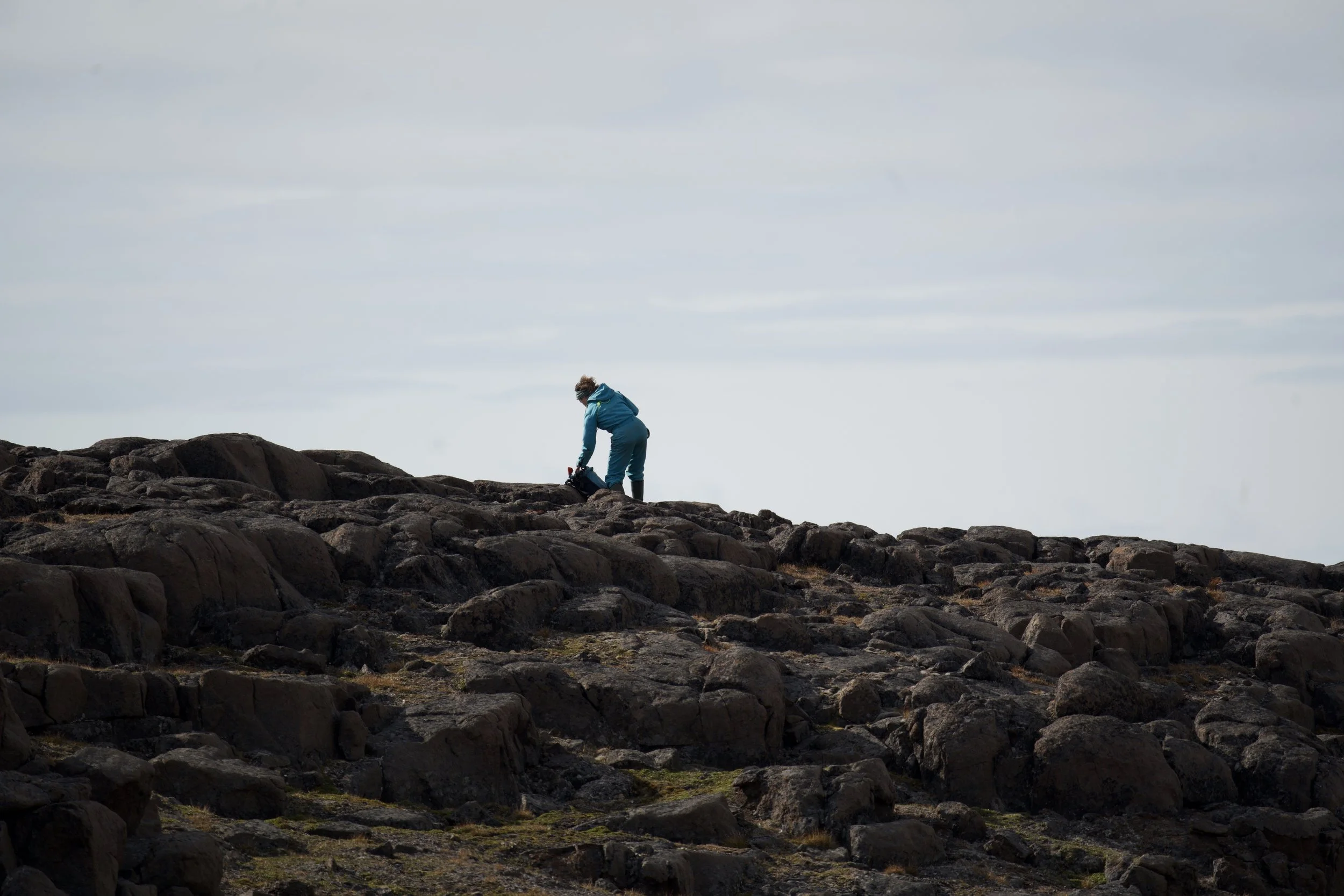
Sarah on top
Sarah handed us to Lisa and went. I said Sarah, can I come, and she did not hear me, and she was already gone across the rock at a pace I was not going to match. She was climbing to somewhere she could see from, which is what she had done the morning before from the top of a dolerite cliff while the rest of us got into boats. My last frame of that morning is her at five hundred millimetres, one small figure crossing open ground, going up to look.
I walked down slower than anyone. I kept turning around. I was hoping for a shape on a ridge, a movement, anything, and there was nothing, and eventually I put the life vest on and got in the boat with everybody else.
At lunch I said to Cathleen that I wished we had gone on the long walk, and it came out wrong, as though the morning had not been one of the best walks of the trip, which it had. I was bummed and I am not going to dress it up. What I knew at that point was that four people and a guide had run into two bears. That was the entire brief. It sounded exciting to me and had just missed by choosing the wrong option off a list at nine in the morning. My mood went down and sat there through the meal.
Then the five came in with Beth and took a table on their own and did not talk to anybody. Beth asked the room to give them space and let them process it. The room received this instruction with the same care it had been giving the magnet board for nine days. Some people went straight over. I took myself out on deck, because Gergő is my roommate and he would be three feet from me, vertical, at bedtime and there is no hurry with a man you sleep that close to.
The story came out in pieces, and it was not the story I had been sulking about at lunch. Two bears, a mother and a cub. Eleanor saw them first and said what's this, and then the group did what the group is trained to do, which is walk together and never run. The bears came after them. Not away. After them. Beth put a flare up, and that was the shot we had all heard on a hillside and filed under nothing. She could not raise the radio from where they were, so for a stretch nobody on that hill or on that ship knew anything at all. Heidi went into mud past her boot and went down with her camera. Eleanor, who hikes the way other people breathe, wanted to run and had to hold the pace of the slowest person there, which is the whole discipline in one sentence. Gergő told me in the cabin that he feared for his life. He said it plainly and then we talked about something else. I keep coming back to how calm Beth was through all of it, and to the fact that the guides on this ship are that good every single day.
That morning at breakfast the captain had put it at once every three years. By lunch he was three for three inside a day and a half.
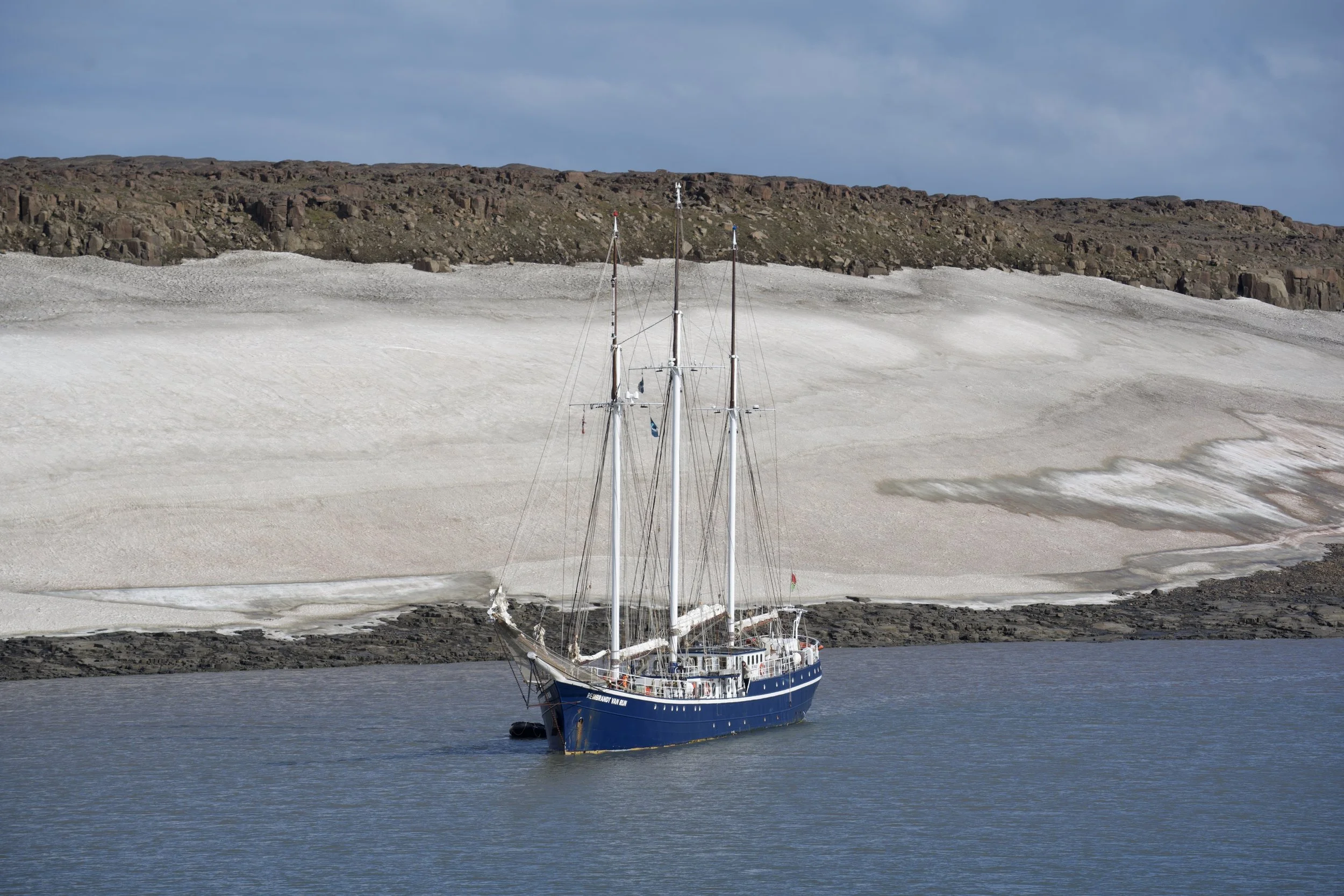
The Rembrandt
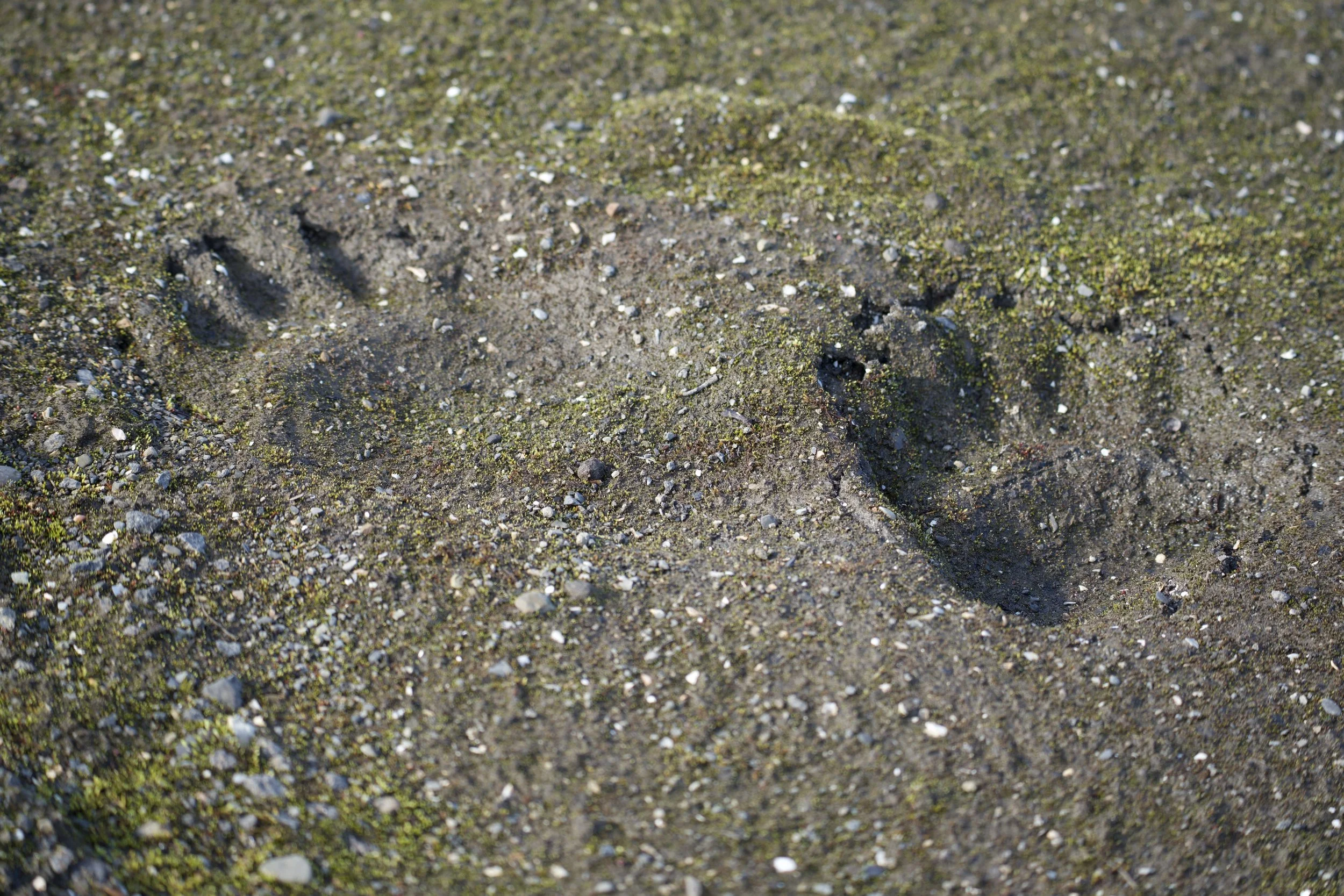
In the afternoon I took the long walk. Sarah led it, with Hattie, Cathleen, Seth and me, and I took it because I wanted to see a bear. That is the whole reason and there is no better one. We were not far in when we found fresh prints in wet sand, front and back, less than a day old. I had the camera ready for the next hour and a half and I never once needed it.
But the stone had been right. Look at what it actually gave me. Not a bear. A print. It handed me a paw pressed into rock at ten in the morning and then the ground handed me a paw pressed into sand at four in the afternoon, and four other people and a guide got the animal that made them. The stones had been accurate since Witches Bay, which was yesterday. Two days into owning a working oracle and I was already treating it like a waiter who had brought me the wrong order. They keep being right, and being right is the problem.
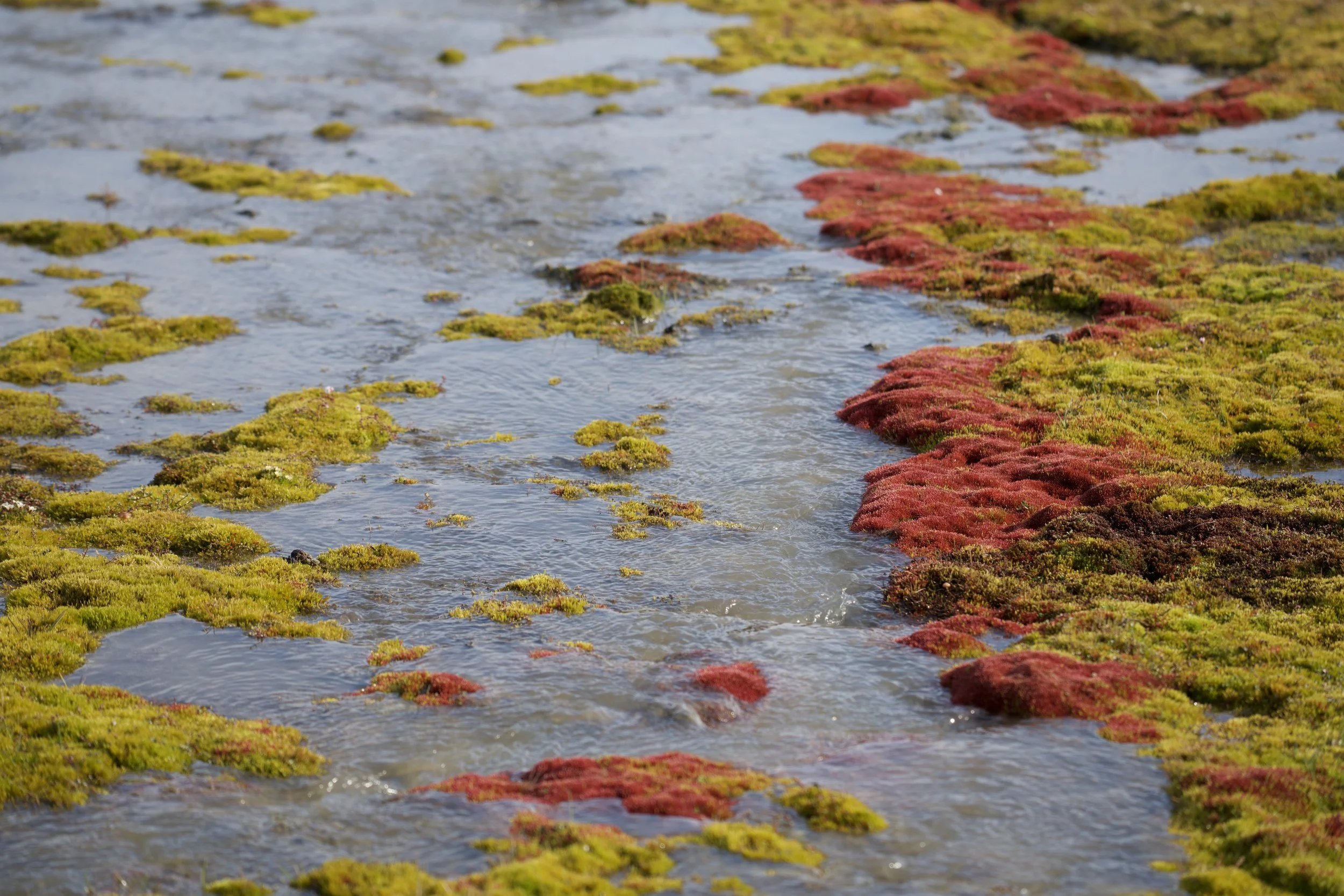
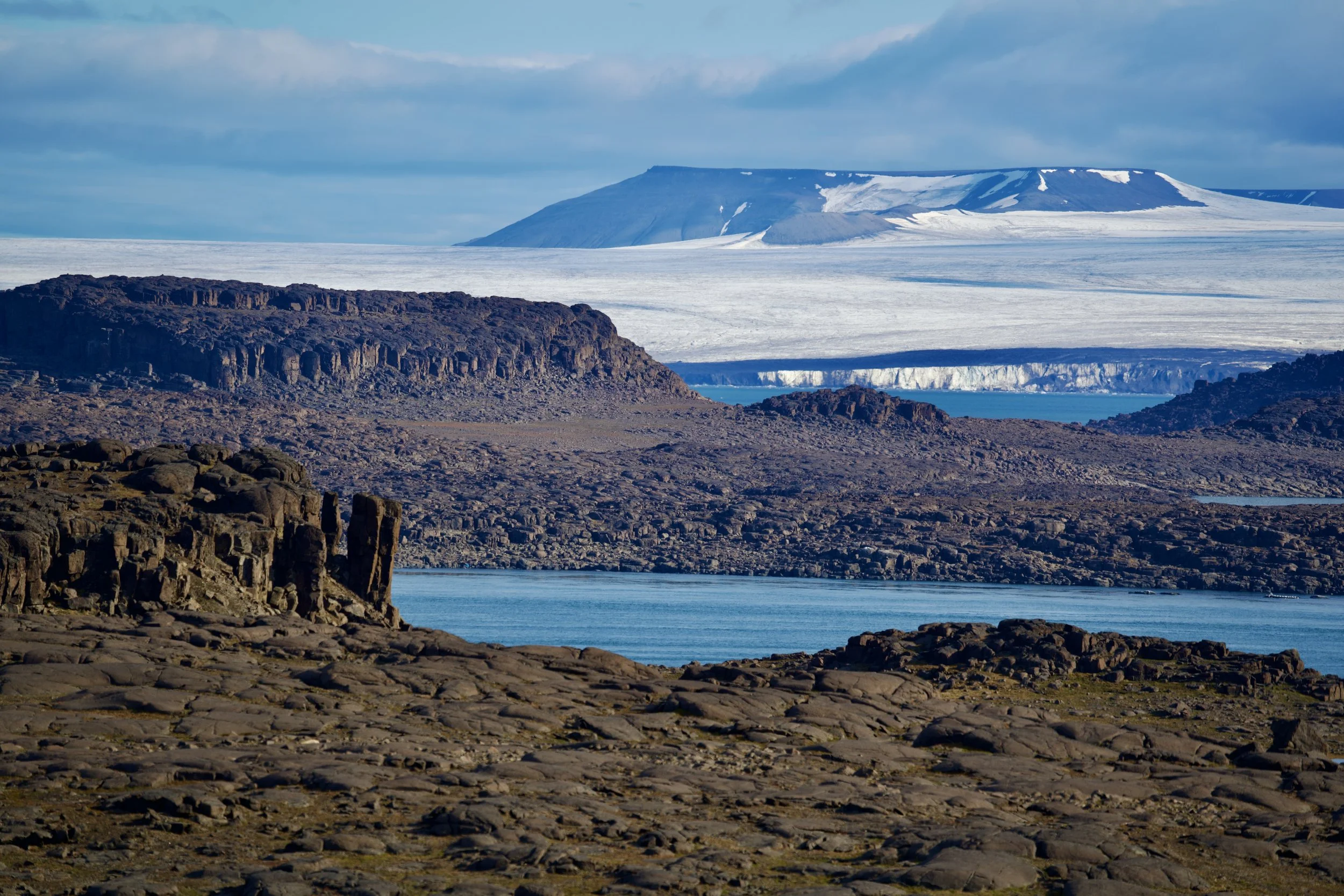
The rest of that afternoon was as good as anything on the voyage. Meltwater running between cushions of moss in green and red so saturated it looked printed. A glacier across the water and an ice cap standing behind it. Reindeer far out, two dots that turned into two more dots when you looked longer. And a set of pools that Seth had somehow known about and wanted, so Seth got in, and Hattie got in, and Cathleen got in, and I stood at the edge like a sensible man and declined. Sarah told me I would regret it. She said this is the last time you will ever be here. I put that at about ninety per cent, which leaves ten, and I will take ten.
Coming down we went looking for snow. There was a patch of it on the slope and the whole group, Sarah included, decided it was a slide, and it was not a slide. Not steep enough, not enough of it, and five adults took turns proving this to each other in a place where the nearest other human being was a very long way away.
And then the ground did it again. A dark cobble sitting in a field of pale broken plates, and set into the face of it a long light curve with a hooked end, a head to the right and a mouth line running back from it. I stood there with it in my hand and ran the account out loud, to Cathleen, on a slope in Svalbard. A bear in a rock and then a bear. A seal in a rock and then a seal. A paw in a rock this morning and a paw in wet sand this afternoon. So. Whale next. She looked at me the way you look at a man who has just called a coin toss and is standing there with his hand out, waiting.
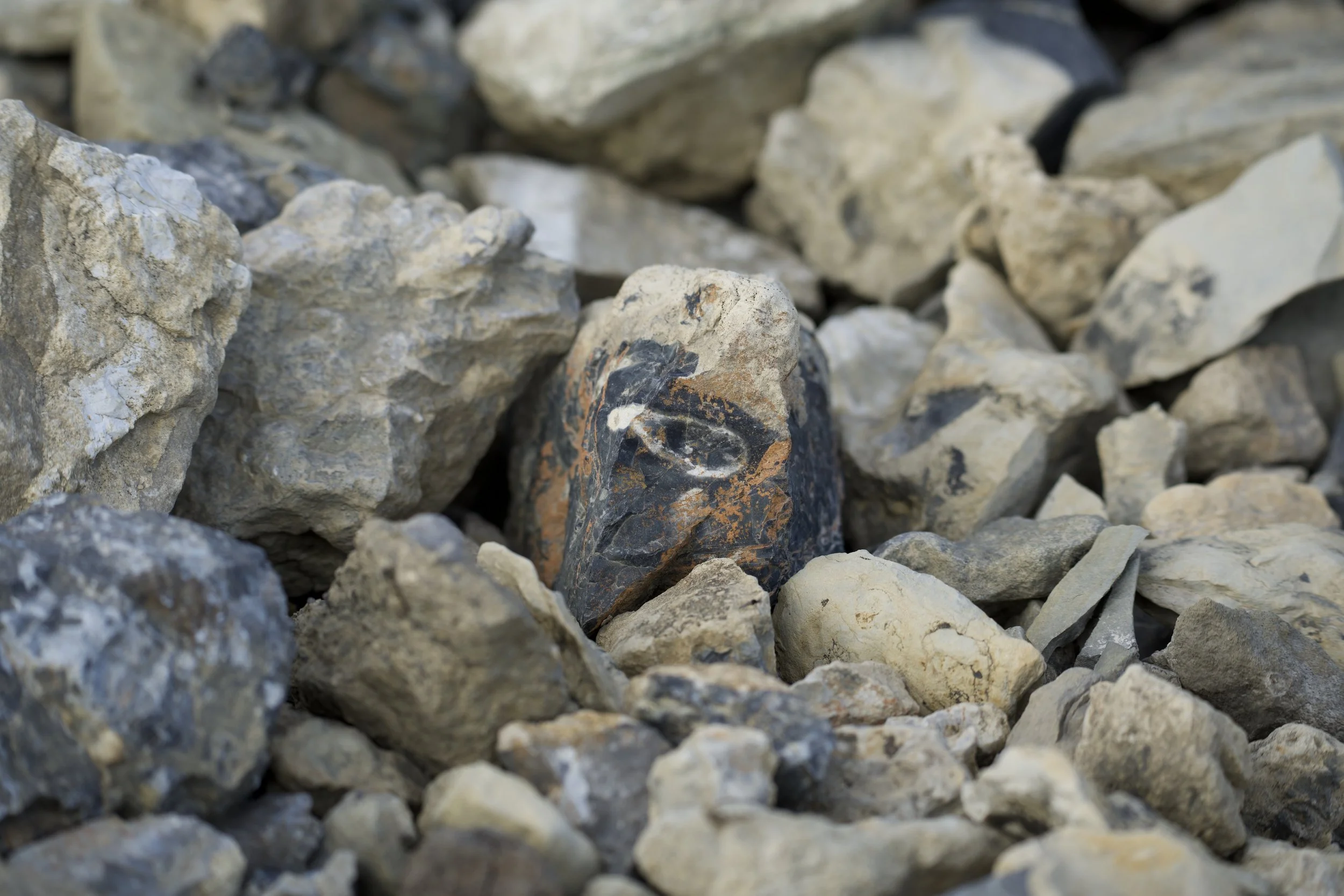
Clearly a smiling Whale
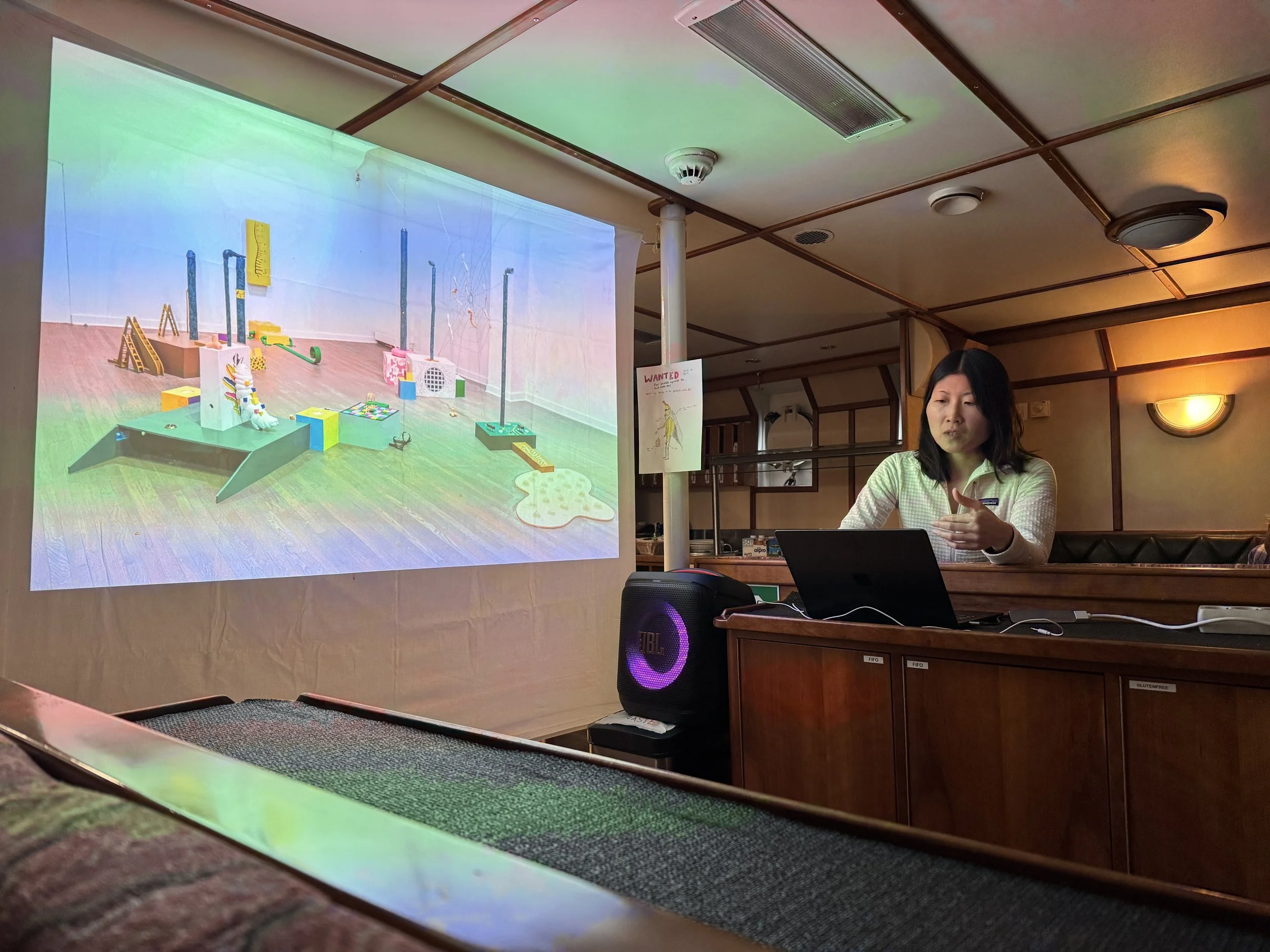
Presentations at quarter past eight. Ling-lin was my favourite of the evening, the crime scene she is building out of architecture and familiar objects at the wrong size, everything lit from somewhere it should not be. She came in on time. Others did not. The ten minute rule, which had held so beautifully on the first night that I wrote a whole paragraph about it, went out of the window, and by the third overrun the room had developed a mood you could photograph.
We weighed anchor at ten and stayed up on deck with drinks, and at about five past eleven the walls came in on both sides.
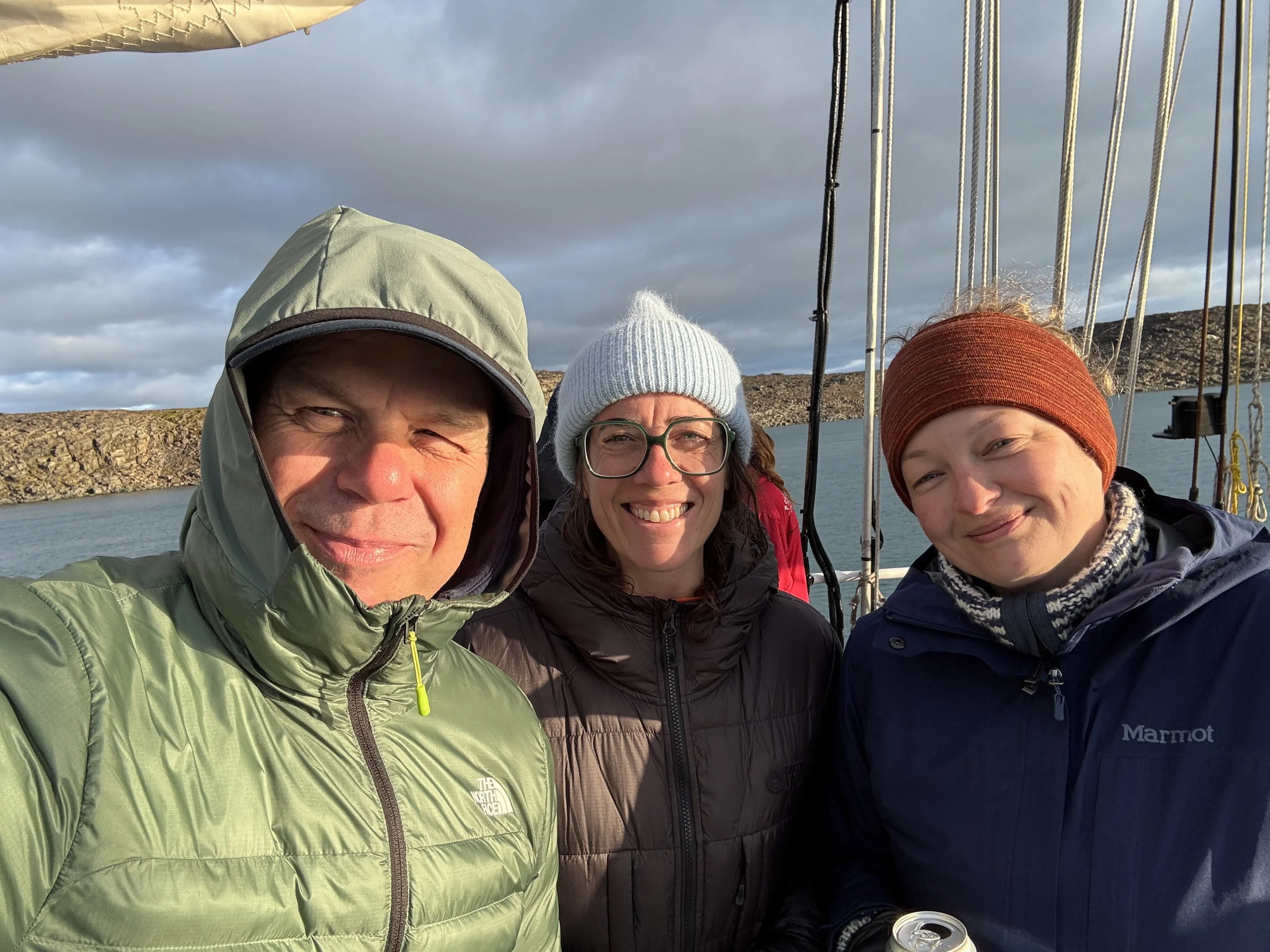
The channel is called Ormholet. It means the worm hole, and it is one nautical mile long and about a hundred and fifty metres wide, which is three of our ship laid end to end. It runs between Barentsøya and a small island called Kükenthaløya, and it is the narrowest of several passages through there. The big one to the north, Heleysund, is six hundred metres across and deep. Ormholet is the one you take when you are small enough to want to. It is also the reason the ship had been fighting current at two that morning coming in, because the tidal streams through those channels can run to ten knots, which is faster than most people can swim and about as fast as our ship goes flat out. You wait for slack water, when the sea stops for a few minutes and forgets which way it was going, and you go through in that gap. If there is drift ice in the channel you do not go at all, because the ice comes through at the speed of the current and it has crushed vessels before.
The whole area is inside the Søraust-Svalbard nature reserve and there is one piece of land in it that is not, which is Straumsland, on the north side, which is the ground we had walked on twice that day. Since the start of last year, no ship carrying more than two hundred passengers may go into the reserves at all. So the reason you do not see anything large in that channel has nothing to do with whether it would fit. It would never get near enough to try.
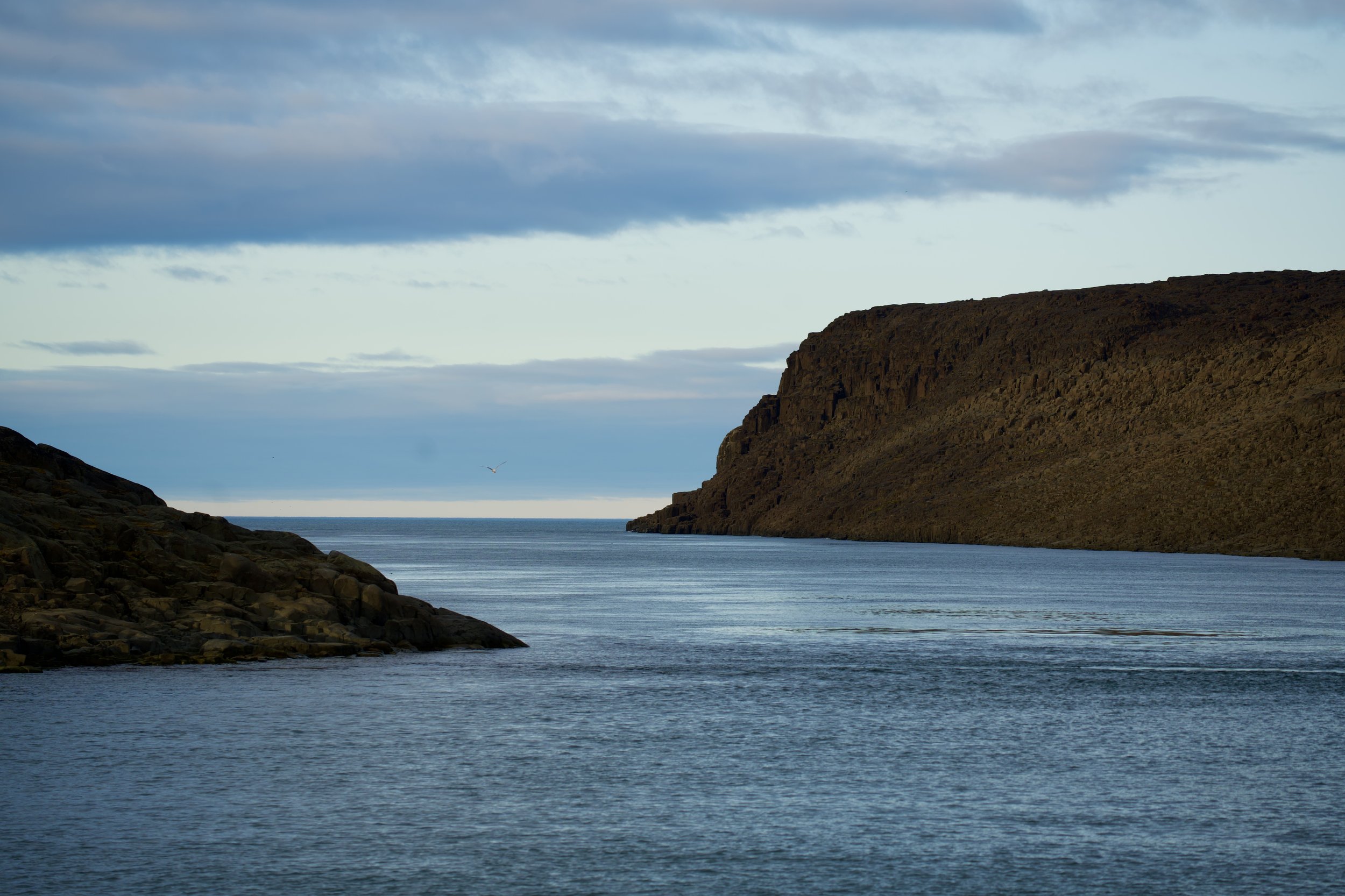
Ormholet
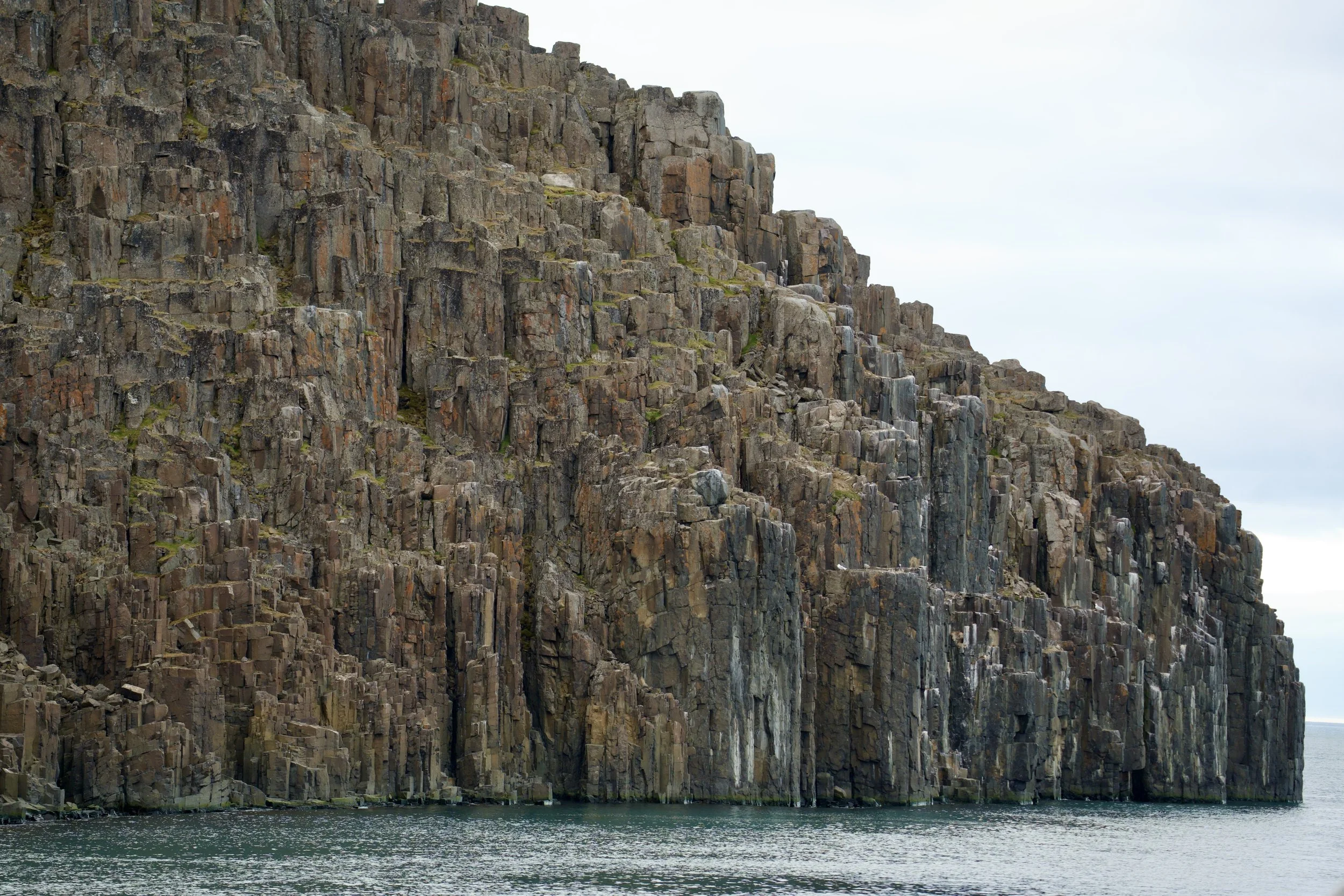
And the passage is so hard to see from any distance that people believed for two hundred years that Barentsøya was part of Spitsbergen. The strait was found and named in 1617 by a sixty-ton ship called the John Ellis, sent out by the Muscovy Company to look at what lay southeast of Spitsbergen, and named for William Heley, an Englishman who spent the following six years as supercargo and vice admiral of the English whaling fleet up here. The same company that gave a bay its name in Entry Forty-Four. They were thorough about this sort of thing.
Somebody on deck said the thing everybody was waiting for somebody to say, which is that if you go through a wormhole you come out in a different time. I asked whether I could have the eighties back please. Cliffs of stacked columns on both sides, close enough to feel, birds sitting all over them. Sarah went up the mast to watch us through. From up there somebody spotted bears on Kükenthaløya, and it was one or two of the crew, and nobody could tell me afterwards what time it happened, and I do not think a single passenger saw them. The ship added a bear to its count that most of the people standing on it never knew about.
I went to bed at seventy-eight degrees thirty-eight north with four stones behind me and a prediction on the record in front of two witnesses.
“We are ruled by the forces of chance and coincidence”